
Trump Accounts Need Tweaks
And an idea for a new financial product for someone to offer
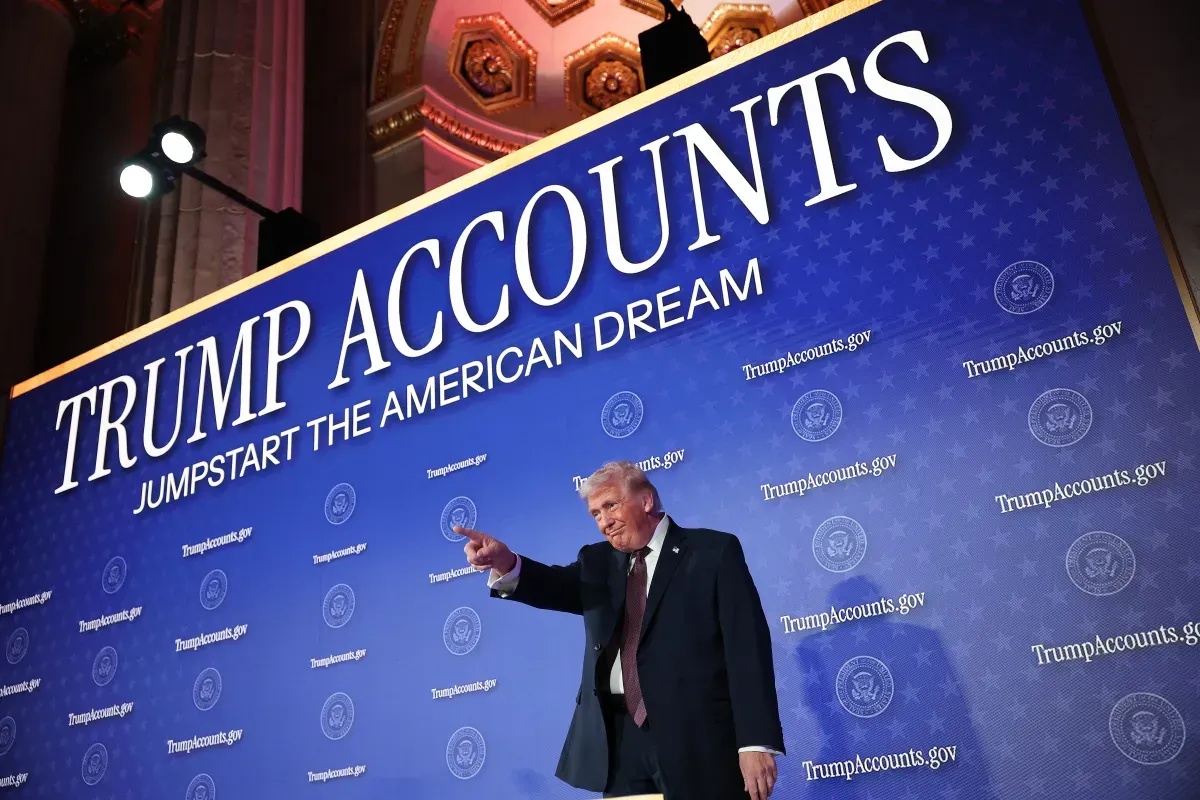
One of the ideas being floated by the Trump Administration to buy votes for the midterm elections help middle-class Americans is the Trump Accounts.
Trump Accounts are designed to give every eligible American child an early start in building wealth through long-term stock market investing. Kids born between 2025 and 2028 get a one-time $1,000 gift from the Treasury, and then people can contribute up to $5,000 per year. Like 529 plans or IRAs, all growth is tax-deferred until the kid withdraws at some point after turning 18.
Investments are limited to low-cost index funds.
Wealthy philanthropists (e.g., Michael Dell, Ray Dalio, etc.) will contribute money for kids who won’t get the government dollars.
Here’s Treasury Secretary Scott Bessent talking up the Trump Accounts:
He said 600,000 Americans have already signed up for Trump Accounts, and expects millions more to do so.
I guess I don’t hate the idea, but it needs a significant tweak. Putting tens or hundreds of thousands of dollars into the hands of 18 year olds strikes me as a questionable disastrous decision. Allowing $5,000 in contributions is nice but it isn’t clear to me at all that working families have an extra $5,000 to spare to contribute.
Here then are my tweaks to the Trump Accounts to maximize their impact.
Self-Directed, More Freedom
The first change is to remove the requirement that Trump Account funds be invested only in low-cost index funds/ETFs. I know the justification is that they want most of the funds to go to the investors, rather than to the investment advisors with very high fees.
However, that’s for the investor to decide, isn’t it?
Plus, today most investors are looking towards retirement and truly need to protect whatever wealth they may have accumulated. Low-cost index funds and such might be ideal for such investors.
For kids who haven’t even entered the workforce, that calculation is dramatically different. If a 10 year old decides to take a swing on a high-risk opportunity, and loses it all, what has he actually lost? It isn’t as if he isn’t going to be working the rest of his life until retirement anyhow.
One of the motivations for the Trump Accounts is to expose more Americans (only 38% of American families have any investments in the stock market) to the world of investing and finance. Well, limiting choices to index funds and ETFs is hardly exposing anybody to the world of investing and finance. A more passive form of investing does not exist.
It makes far more sense to allow the kids (with parental guidance and permission) to invest their funds wherever they want. Individual stocks, IPOs, crypto, commodities, whatever. They’re playing with house money, and gains are tax-free; let them learn investing, risk vs reward, how to research opportunities, etc. etc. by losing their ass on a bet from time to time. It isn’t as if they can’t make house payments from their forays into investment: they’re kids.
Or, they can be very conservative and stick to index funds and such. Let the family decide.
A Change to Contributions
The $1,000 seed is nice, whether from the government or from philanthropists. But that $1,000 will result in (official estimates from White House Council of Economic Advisers) $5,800 by age 18, based on historical S&P 500 returns.
If the family contributes the maximum $5,000 per year, that amount skyrockets to $303,800.
Of course parents and grandparents and such will contribute the maximum. If they can.
Except that we’re currently living in a country where 67% of Americans (PNC Bank Financial Wellness Report, 2025) say they are living paycheck to paycheck with zero savings. Data-driven studies suggest 24-25% of households with zero savings. Quite a few reports/studies/surveys say that some 60% of Americans couldn’t cover a $1,000 emergency from savings.
Expecting working class families to contribute to the kid’s Trump Account when they are having to pick what items to put back at the grocery is expecting too much.
I would make two changes:
- Labor laws allow kids to start working at 14. Obviously, family farm and family business work is not regulated. Anyone under 18yo should have the first $5,000 of his income tax deposited into his Trump Account.
- Parents with children below 14 will have the first $5,000 of their income tax deposited into their children’s Trump Account, per child. Once the child is able to work, the parental deposit goes away. You want financial literacy? No better way than working for money.
This way, even working families are able to contribute the maximum to their children’s Trump Accounts without having to skip ground beef for the month. It makes zero sense to allow wealthier families to set their kids up even better for the future compared to poor and working families. The point is not to widen the gap, but to narrow it some.
Wealthy families will still have an advantage. They’ll just put $5,000 into the kid’s Trump Account and have their children do after school karate or unpaid internships instead. But at least the working family has a chance to set their kids up with $300K at 18yo, instead of $5,800.
Yes, that contribution is “coming from the government” by way of foregone tax revenue but uh… the sooner Americans learn that anything “from the government” is actually from their own pockets via taxes, the better.
Tax Free Usage
When the kid turns 18, the Trump Account turns into a traditional IRA. Which means withdrawal is taxed with a 10% penalty before turning 59-1/2.
Yes, it can be used without penalty for purchase of a first home, but the withdrawal is taxed as ordinary income. I would change that.
Withdrawal from a Trump Account for the purpose of a first-time home purchase should be tax-free, provided that it happens before the beneficiary (child who is now an adult) turns 25. I would also allow for tax-free withdrawals before 25 for education and for starting a business.
If you want a vacation to Bali, pay the tax and the penalty. But if you want to buy a house, pay for college, or start a business… the whole point of the Trump Account was to set you up for success as a young adult. Go get it with the full amount of your investment.
I went with 25 as the age cutoff because frankly, that’s when young people need the most help. They’re starting out in life, just past their entry-level job, and maybe dating seriously. The time to have a boost is then. If you’re 35 and thinking about buying your first house… well, pay the taxes then since you are already likely far more established in your career and such, and chose to defer on homeownership.
Nothing More Important
I believe that almost all of our problems stem from unaffordable housing. I have written about that in the past.
Most of our division, civil strife, economic problems, lack of marriage and childbirth, etc. etc. have to do with young people not having housing. Fix housing, and fix society.
So the Trump Account is a fine longterm idea for solving that critical problem. But the tweaks are needed to do that.
The rich and their children are not the ones interested in communism or burning down their cities; it is the working class, formerly-middle class, and others who have such discontent and despair that are open to burning everything down. Couldn’t be worse than what they have today, right?
The current Trump Account structure ensures that poor and working families have no chance at homeownership. What’s $5,800 gonna do for a 18 yo kid to buy a house in 18 years? Nothing. $300,000 on the other hand could be a downpayment even in 18 years when the median home price will be $850,000 (at 4% long-term historical average growth rate).
We must create a way for poor and working families to contribute to the Trump Account without actually having to come out of pocket. They can’t afford it. Also, taking 30-50% of the $300,000 saved up in taxes even without the penalty makes that no longer a sizable down payment. Make it tax-free for first-time home purchases; that gives actual hope to young people.
If two such young people get married before buying a house, then collectively, they have $600,000 to buy the house, maybe start a business, and maybe pay for furniture for the baby’s room.
Granted, this doesn’t help the 25 year old today. That’s a topic for another day. But at least for America’s working and middle class families struggling to make ends meet, these tweaks would make the Trump Account something more than a short-term vote-buying effort.
Your thoughts are particularly welcome.
-rsh