The Seven Most Interesting People in Real Estate, 2025
The annual tradition returns

Welcome to another installment of an annual tradition around here: the Seven Most Interesting People in Real Estate. This post will be too long for email. Please come read it on the website if you’re getting this in your inbox.
As in earlier years, let me reiterate that Inman does the Influencers list, Swanepoel does the Power 200 list, and RISMedia does the Newsmakers list. All of them are far more respected and important than this list of mine for a bunch of reasons. Inman Influencers er… have influence. Swanepoel’s SP200 takes hundreds of hours of work and those people have real power. RISMedia’s Newsmakers are nominated by readers and selected by RISMedia for “making headlines for the right reasons.”
The Notorious ROB Interesting List is none of those things, although there are obvious overlaps because I find influence and power to be interesting. It is simply a list of people I find interesting for a variety of reasons. They may or may not be influential, may or may not be powerful, and in fact, you may or may not have heard of them at all. But I find them interesting, and it’s my list. Sunny Hahn and the 2025 special advisor Woodford Reserve Double Oaked have assisted in this list.
Without further ado, Notorious ROB presents, The Seven Most Interesting People in Real Estate in 2025. As in previous years, this list is in no particular order but rank them as you see fit!
1. Ethan Glass, Compass

As of September of 2025, Ethan Glass became the Chief Legal Officer at Compass, at a very interesting time in the company’s history as well as the industry’s history. What makes the appointment especially interesting is Glass’s background as a lawyer. From the Compass press release:
Glass brings decades of experience in antitrust litigation, previously leading teams in the U.S. Department of Justice (DOJ) that investigated and sued Multiple Listing Service (MLS) organizations for anticompetitive conduct. He most recently served as Head of the Global Antitrust and Competition Practice at Cooley LLP, one of the leading technology law firms in the country. His appointment reinforces Compass’ commitment to protecting seller choice, challenging coercive industry practices, and empowering agents to market their clients’ homes without restrictions from MLSs and third-party platforms like Zillow, whose business models are based on altering and monetizing listings at the expense of homeowners and their agents.
Normally, corporate general counsel’s have a corporate background. No duh, right? They come out of corporate, M&A, maybe securities or capital markets or perhaps employment law or maybe have a background in tax law. The things that most corporations have to deal with on a day to day basis.
Glass is not only a litigator—which is somewhat rare among corporate general counsels—but an antitrust litigator with long experience and a sparkling track record at the DOJ. He was a trial lawyer, which is not actually that common among litigators, and was Assistant Chief of Litigation at the DOJ. In that role, he led several high-profile antitrust investigations and trials such as U.S. v. American Express, which the DOJ won at trial, then was ultimately reversed by the Supreme Court. It was and is a landmark case.
Less known, because it really wasn’t a big case, is that the DOJ under Glass went after Consolidated MLS in South Carolina in 2008. So he knew about the MLS and Associations back then.
Glass shifted to defending NAR in private practice, first at Quinn Emanuel Urquhart & Sullivan, and then at Cooley. He was famously NAR’s chief outside counsel in cases like Sitzer, Top Agent Network, REX, and the NAR v. United States.
In other words… Glass is what Michael Corleone would call a wartime consiglieri. He’s not the guy you want looking over bond offering documents or M&A paperwork. He’s the guy you want when you’re looking to go after somebody, and to defend against anybody coming after you.
The signal is as clear as could be. Robert Reffkin wants to go to war and is ready for war.
In contrast, the general counsels of Zillow and NAR respectively are Brad Owens and Jon Waclawski. Owens has a far more typical corporate GC legal background in securities law, corporate governance, and M&A. Waclawski comes out of politics, working for Republican Party of Wisconsin, RNC, and other political organizations. Both are, I imagine, great lawyers but they’re not litigators, never mind trial lawyers.
Now, that doesn’t necessarily mean anything since both Zillow and NAR are big companies with outside legal counsel who are probably warriors. But I imagine that it doesn’t mean nothing that the GC of your company is a decorated trial lawyer either.
The next few years in the real estate industry will be a time of war, not peace. The immediate conflict is between Compass and Zillow, Compass and various MLSs, and to some small extent, NAR. But the massive disruptions that are coming are likely to involve more fighting and less negotiating. We already see this in the Compass v. Zillow lawsuit, but let’s not forget that Compass is suing Northwest MLS as well. Assuming that NWMLS doesn’t fold soon, seeing as how Coldwell Banker is one of the three main owners of NWMLS and is about to become part of Compass, that lawsuit would set precedent with other MLSs.
Once the Compass-Anywhere merger goes through—after jumping through hoops, I imagine—then the two sides with two centers of gravity become clearer. One side has a warrior as its chief legal counsel; the other side has a dealmaker as its chief legal counsel. Nobody knows how things are going to go, but if you’re in the industry, you can’t say it won’t be interesting to see the battle unfold.
Yes, generally speaking, companies would rather negotiate and settle. Litigation is expensive, time consuming, and truly a last resort. But this situation reminds me of my days as a summer associate at a big NYC law firm, rotating through bankruptcy department. I watched the head of the department, Harvey Miller (often called the dean of the bankruptcy bar) look through a lengthy negotiation proposal from the other lawyer, simply write NO in big red marker on the front and send it back. He told me then that he came out of the courtroom and isn’t afraid to fight, while the other lawyer was more of a negotiator. He told me that he has an advantage in negotiation because he and the other lawyer both know that he’s not afraid to get nasty.
Ethan Glass strikes me as a guy who is not afraid to get nasty, which gives Reffkin more leverage in negotiation situations. But to prove that, he is going to have to get into some scraps and win some fights.
For these reasons, Ethan Glass is one of the seven most interesting people in real estate in 2025.
Glass brings decades of experience leading antitrust matters in the real estate industry, making him one of the few attorneys in the country who fully understands the intricate complexities of MLS regulations and how platform policies are used to control real estate agents and limit seller choice.
At the DOJ, he was responsible for directing teams that investigated and litigated against MLS organizations for engaging in anticompetitive practices. In private practice, he represented the National Association of Realtors (NAR) in its defense against DOJ scrutiny and private antitrust lawsuits.
While at Cooley LLP, Glass led Compass’ lawsuit against Northwest MLS (NWMLS), a case aimed at restoring homeowners’ rights to decide how their homes are marketed in Washington State.
“I’m honored to join Compass, a company committed to empowering agents and ensuring homeowners retain control over how their properties are marketed,” said Glass. “This is a pivotal moment for the real estate industry, and I am excited to provide my expertise to a company that is so clearly aligned with supporting both its agents and the homeowners they serve.”
Throughout his career, Glass has been at the forefront of some of the most consequential legal battles involving antitrust and industry policies, MLS governance, listing data access, brokerage competition, and platform accountability. He has a rare insight into how the residential real estate industry is organized, how participants in that industry compete, and how rules and regulations impact that competition.
2. Leo Pareja, eXp Realty

Residential real estate has a somewhat unique quality that I have never seen in any other industry. It is dominated by personalities. Think of names like Dave Liniger, Gary Keller, Ron Peltier. Love ‘em or hate ‘em, you can’t deny that these men were among the most charismatic, most forceful, most charming, most dominant men in their generations. And at smaller, local and regional levels, everyone is aware of similar personalities at big brokerages in their markets. I think about people like Matt Widdows or Kuba Jewgieniew and many others who do not merely have large companies, but have personal charisma and force of will as well.
In this generation of leaders, there are two that truly stand out. Robert Reffkin, whom I have profiled before, is one. Leo Pareja is the other. Both men are charismatic, inspire loyalty from their people (especially agents), and are charming guys with forceful personalities.
In recent years and months, Pareja has made significant contributions to industry issues. eXp famously open sourced its buyer agency agreement after the Sitzer settlement, which consumer advocates and third party lawyers agree was a solid and fair agreement in contrast to some of the form agreements we had seen. eXp recently published a form disclosing referral fees, and informing clients about their options. And in speeches and articles and appearances, Pareja has stressed over and over the importance of serving the clients as professionally as possible.
And of course, Pareja has also led eXp to profitability under his tenure, going from a loss of $1.2m in Q2 of 2024 when he was named, to a profit of $3.5m in Q3 of 2025, with 7% growth in top line revenues despite losing agent count slightly.
Of course, Pareja has become THE leader (along with James Dwiggins of NextHome, but eXp’s size makes Pareja the one everyone watches) opposing Robert Reffkin on the hot button issue of private listings. At least for now.
What makes Pareja so interesting—apart from the fact that he’s a great guy, a wonderful speaker, and an accomplished leader—is that he faces one of the great conundrums of the new era as things move forward.
Compass acquiring Anywhere has changed the landscape of the entire industry, but particularly for brokerage companies. Prior to the acquisition, Compass ranked #1 for sales volume (2024 data) while eXp ranked #1 for transaction sides. Anywhere’s in-house company-owned brokerage (operating mostly as Coldwell Banker) was #2 in both. After the transaction closes, Compass will be #1 in both sides and sales volume by quite a large margin.
Now, eXp is unlikely to stand still and just watch that happen. I feel pretty certain that Pareja and team are likely looking at acquisitions and partnerships and other moves to compete with Compass 2.0. So just that scaling up effort is super interesting. As I wrote in this post about the Compass-Anywhere deal, eXp would need to acquire RE/MAX and HomeServices of America to get close to Compass 2.0… or eXp could buy up the entire top 100 brokerages other than HomeServices and Redfin. That would also get it done. Both are industry-shaking deals, if they were to happen. And far from easy.
Easy or not, Pareja has to answer the challenge from Compass. He has no choice. As the philosopher-documentary filmmaker 50 Cent said, get big or die trying.
Part of that will be a reconsideration of private listings. As Pareja has said many times, he did not want eXp to go down the private listings route out of principle, but if he is forced to, eXp would benefit the most from going private given the size and scale of the company. With 300,000 transaction sides in 2024, if we assume that half were listings, then eXp would indeed lead the pack with 150,000 private listings… which Pareja could then leverage for recruiting and retention.
That would, of course, put him and eXp on the other side of where they stand today. Everyone would understand, of course, since the Compass-Anywhere deal could be said to be “being forced” to engage in private listings. Nonetheless, eXp making such a move would make private listing networks the default mode for the industry, with all of the consequences that portends.
Given the different origin stories of eXp and Compass and the different business models of the two companies, the rivalry between them makes for a compelling storyline. eXp got its start as a lower-cost alternative to Keller Williams, famously with no physical offices to cut overhead; Compass got its start as a high-touch, high-tech luxe brokerage brand that would pay agents to switch. Even today, eXp is seen as a low-cost brokerage model with high splits and caps on commissions, while Compass is seen as a high-cost high-service brokerage model.
Other brokerages large and small—well, the small only as long as they continue to exist—will be watching closely to see what the outcome of that battle will be. Most people will see it as the victory of one business model over another, and for the most part, there is a lot of truth in that analysis.
However, in real estate, I think personality matters. I think the actual person who is the head and face of the company matters to agents. Dave Liniger and Gary Keller did not simply grow because of their business models; they grew because agents wanted to follow them. Both Reffkin and Pareja are men who agents want to follow.
Robert Reffkin has made the first major move of the new era of real estate. I can’t wait to see how Leo Pareja responds. That makes him one of the most interesting people in real estate today.
Official Bio:
Leo Pareja began his real estate career at the age of 19. By 28, he had become the #1 Keller Williams agent worldwide. Over his 15-year career in sales, his team personally sold approximately 4,000 homes.
In 2012, he co-founded Washington Capital Partners, transforming it into one of the largest private lending companies on the East Coast, with over $2 billion in originated hard money loans. In 2016, he co-founded Remine, which quickly became the fastest-growing MLS platform in the industry—capturing 80% market share and serving more than 1.1 million users.
After successful exits from both WCP and Remine, Leo joined eXp Realty’s executive leadership as a named officer of EXPI. He has served as President of Affiliated Services and Chief Strategy Officer, leading strategic initiatives that have strengthened eXp Realty’s competitive edge and agent value proposition. He currently serves as CEO of eXp Realty.
Leo has been named to the Swanepoel Power 200 (SP 200) six times, recognizing him as one of the most powerful and influential executives in residential real estate.
In 2020, Leo co-founded the Pareja Family Foundation, a nonprofit dedicated to addressing economic disparities by equipping individuals with the tools and opportunities to achieve financial independence. The Foundation supports women, minority-led startups, and underserved communities through education, mentorship, and financial assistance. It offers a Financial Literacy Course—developed in partnership with Miami Dade College—that teaches essential financial skills for long-term success.
By investing in economic equity and empowering the next generation, Leo continues to drive meaningful impact beyond the real estate industry.
3. Jennifer Butler, Zillow

Lawsuits are bad for everybody involved… other than, I suppose, the lawyers making bank on them. But if you’re not involved, they can be interesting because facts and stories you didn’t know often come out to the public since lawsuits are public disputes.
One of the most interesting revelations in recent years came from the preliminary injunction hearing from Compass v. Zillow. I know you’ve seen some social media coverage of it, but we were treated to a strategy plan memo from Zillow. Now, the memo predates changes to CCP, and I have been reliably informed that all of that was just brainstorming and scratchwork that led to Zillow’s ZLAS and there is no other strategic plan in effect today.
That may or may not be the case, but that memo revealed something few of us has even thought about. Take a look at this “Working Plan Overview” from the memo:
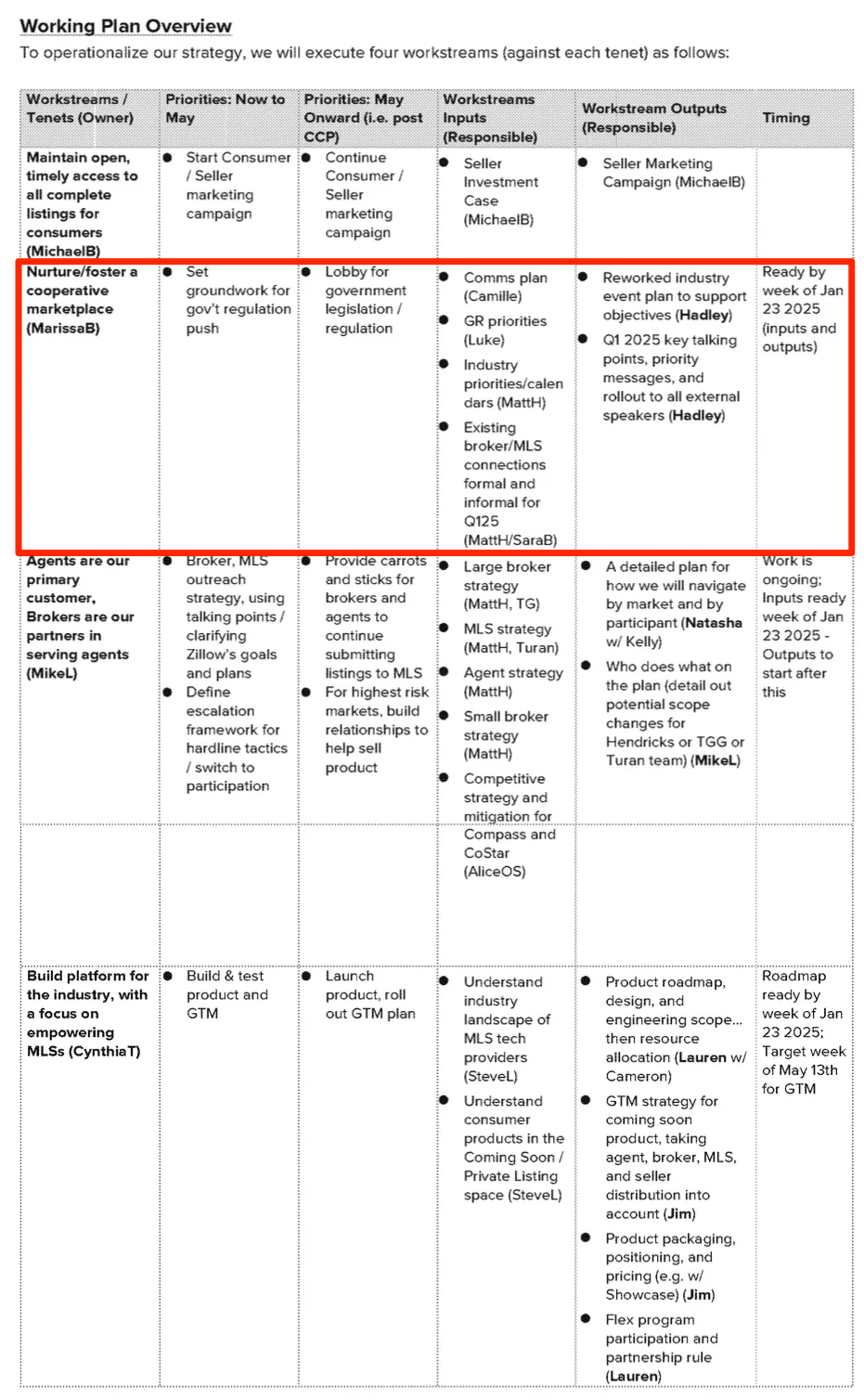
“Set groundwork for gov’t regulation push” is the main priority until May of 2025, and then the priority shifts to “Lobby for government legislation/regulation.”
The plan further lays out GR (“Government Relations”) engagement plan:
GR engagement plan: focused on “fair and transparent access” to real estate informationIdentify and activate third-party validators. Continue gathering intel from relevant stakeholders, and recruiting third-party validators that can be leveraged to amplify our messaging (in collaboration with Comms) to target political and regulatory decisionmakers.Regulatory guidance. Engage with regulators to publish clarification on existing rules, and/or issue written warnings to brokers and agents on their existing fiduciary obligation to represent sellers’ best interests.New regulations or legislation. Propose public policy that requires brokers and agents to ensure listing transparency and give sellers informed choice on listing exposure.Consumer advocate scrutiny. Mobilize local and national organizations to publicly warn brokers and agents on the fair housing risks of reduced access to real estate information.
Now, it’s no secret that big companies lobby governments. If I recall correctly, Anywhere once had a significant lobbying arm as well, and Big Tech (which Zillow is kinda sorta part of) certainly has major government relations efforts. But we in the industry are not used to thinking of Zillow as a lobbying organization.
Turns out, Zillow does have a small but highly effective GR team, estimated to be between 6 and 8 staffers and perhaps a dozen external lobbyists. Jennifer Butler is the leader of that team and there is plenty of evidence to suggest that she and her team are methodically and effectively executing on the plan (which Zillow says does not exist).
For instance, Zillow began sponsoring ARELLO (Association of Real Estate License Law Officials) in 2022 but it was just for an offsite reception. In 2024, Zillow increased that involvement to a formal Silver Sponsor at two events, and in 2025, Zillow was the Platinum Sponsor of ARELLO’s Mid-Year Meeting and its Annual Conference. Perhaps it is merely coincidence, but in 2025, Zillow and ARELLO held a joint webinar on Private Listing Networks:
I assume most people would be bored to tears by this topic and by this panel, but regulators (who are members of ARELLO) would have been the target audience anyhow. I believe Zillow presented at both conferences as well.
That’s one leg of the plan, “engage with regulators” being executed extremely well. What about messaging to “target political and regulatory decisionmakers” and mobilizing local and national consumer advocacy organizations?
Well, we have this: “Chicago shows how private listings can reinforce segregation in housing - and it’s a warning for the nation.” That was a report released by Zillow, including work from Elizabeth Korver-Glenn, a UNC professor, who says in the press release:
“I learned that the real estate agents tap their social networks as primary tools for generating business. Because those networks are racially structured, white real estate agents end up working primarily with white home buyers and sellers, while Black and Latino agents deal with more diverse sets of clients,” Elizabeth Korver-Glenn wrote. “Because white agents’ networks are overwhelmingly comprised of other whites, this means that Asian, Black and Latino consumers are disproportionately excluded from finding out about informally listed homes for sale handled by white agents.”
Korver-Glenn wrote that private listings are “a prime example of a practice that legislators [who are] committed to interrupting stubbornly persistent racial segregation in housing markets can and should target.” [Emphasis added]
When Yahoo! News reported on this “digital redlining” story, we get this:
As Zillow and MRED trade attacks about the scale of the problem, an Illinois fair housing advocate said he has been worrying for years about the threats private listings pose.
“I have had this unshakeable, deep concern that this migration toward more and more private listing networks will just create a new age of redlining,” said Michael Chavarria, executive director of Wheaton-based HOPE Fair Housing Center. [Emphasis added]
Sounds a whole lot like “mobilizing local organizations” to me. Effective, especially when targeting regulators and legislators.
Finally, there is this: Wisconsin AB 456. This bill has passed the legislature and is awaiting the governor’s signature as of December 4th. One assumes it will be passed into law. This bill/law says in part:
452.1355 Transactions involving residential property.
(1) A listing firm representing an owner in a transaction involving the owner’s residential property containing one to 4 dwelling units shall, except as provided in sub. (4), do all of the following:
(a) Share information on the property with any licensees representing prospective buyers or tenants.
(b) Respond to inquiries from any licensees representing prospective buyers or tenants.
(c) Make the property available for showing to prospective buyers or tenants.
(d) Within one business day from the start date of any agency agreement authorizing the listing firm to sell or lease the owner’s property, advertise or market the owner’s property for sale or lease on one or more Internet platforms or websites accessible to the general public and any real estate licensees representing prospective buyers or tenants, unless the owner completes and signs a disclosure and opt-out form prescribed by the department that includes all of the following:
According to Grok (and I’m not going to look it up to verify it), Zillow had registered interest in AB 456 through Wisconsin’s lobbying system. So had Wisconsin REALTORS, who supported this bill. That is in line with the Zillow strategy plan:
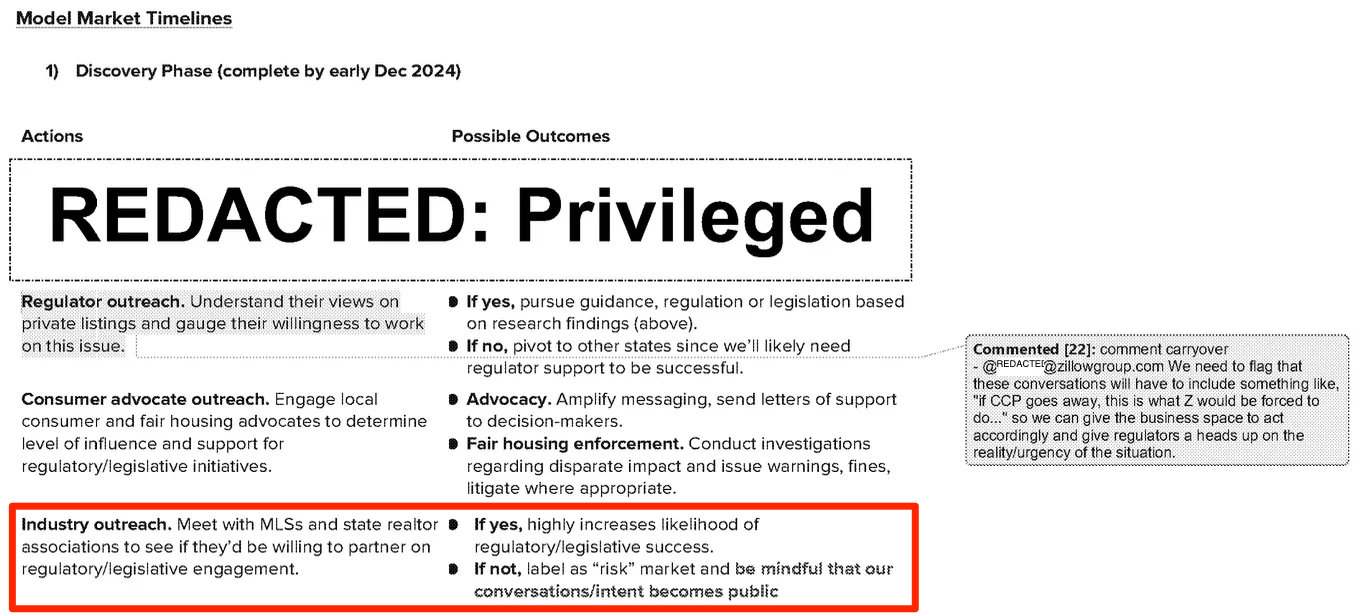
Very, very effective. Truly impressive. I assume similar efforts, with similar alliances with the state associations/MLSs, are underway in other states right now.
Given success on the messaging front, success in engaging with regulators, and what appears to be success on the legislative front, Zillow’s GR team deserves to be recognized. Jennifer Butler, a figure more or less unknown in the industry, is the leader of that team. By all appearances, she and her team are executing like clockwork. And in the battle over private listings, Jennifer Butler working behind the scenes may be the secret weapon that neutralizes whatever happens with MLSs or Associations or brokerages.
After all, Compass could win its case against Zillow. It can strongarm every MLS to allow private listings, especially after absorbing Anywhere. It could force every brokerage, including eXp and NextHome to embrace the three-phased marketing program. None of that matters if the legislatures come over the top and prohibit private listings. Zillow’s power on the lobbying front is as yet unknown, but all evidence is that it is substantial with Jennifer Butler at the helm.
She is one of the most interesting people in real estate.
Official Bio:
Jennifer Butler is the Vice President of Government and Community Relations at Zillow which includes Advocacy, Public Policy, Public Affairs and Social Impact. She joined the company in 2016 to create the state and local government relations department, as well as the organization’s first community engagement program, leveraging Zillow’s platform to address social issues at the intersection of housing and technology. In 2018, Jen relocated from the headquarters in Seattle to New York City to expand Zillow’s civic footprint beyond the western region and build a national team to engage with non-profits, businesses, and policymakers across the country. Previously, she managed Russell Investments’ government and community relations efforts in Seattle and worked at McBee Strategic Consulting in Washington, D.C., managing federal advocacy for clients in the Pacific Northwest on transportation, energy, and public sector issues. Jennifer has a BA in Political Science and Sociocultural Anthropology from The George Washington University and is a fellow of the National Committee on U.S.-China Relations’ Young Leaders Forum and Harvard Business School’s Young American Leaders Program.
4. Damian Eales, Move, Inc.

The news of late has been full of portals. Zillow of course leads the pack, but CoStar/Homes.com is oft mentioned as the archrival of Zillow, including in Zillow’s own strat plan. Redfin, of course, was much in the news because it was acquired by Rocket, and there was much speculation—including by yours truly—about what that means for the industry. Quite absent from the conversation is the former #1 portal, the one that everyone talked about, the one that the industry revolved around as recently as ten years ago: Realtor.com.
Since 2023, the Australian veteran of News Corp Damian Eales has been Move’s (the actual company that operates Realtor.com) CEO. Word is that he has quietly rebuilt Realtor.com to be a real player, cleaned up a bunch of internal dysfunction, and everyone who has ever met and interacted with Eales has high praise for him. He has had a few high-profile public appearances, many of them surrounding the kerfuffle with Homes.com, and has scored some points against CoStar’s legendary CEO, Andy Florance from places like the Inman stage. More than one high-level executive in real estate has told me that Damian Eales might be the smartest operator in real estate tech today.
I think he will have his hands full in the near future. As 2025 winds down, Realtor.com is heading into one of the most critical periods in its long history. The fall of NAR, which began with the loss in Sitzer and the subsequent settlement coincides with Zillow ascending to the Iron Throne and Compass challenging that dominance. The Compass-Anywhere deal changes the industry landscape entirely, and the all-but-written independence of the MLS from NAR presages an era that Realtor.com simply does not know. And of course, the emergence of CoStar/Homes.com under the leadership of Genghis Khan Andy Florance simply cannot be ignored.
While everybody, including me, focuses on Zillow and the competition between Zillow and CoStar, where Realtor.com goes next might be more interesting as a signpost.
To be sure, Realtor.com has been hurting of late with traffic more or less flat at around 77 million monthly uniques since the end of Q4/2024, and revenues hammered throughout most of 2024. Under Eales’ leadership, revenue and profitability appear to be recovering slightly, and discipline has meant improved profitability, but traffic and lead volume both appear to be down, then down again, and then down once again quarter after quarter.
Unique among the major portals, Realtor.com is tied to NAR in at least three ways.
First, its literal name and URL is someone else’s brand: NAR controls the “REALTOR” brand, and Move uses Realtor.com under license from NAR. It is the only portal that does not control its own brand, and if the “REALTOR” brand gets tarnished, there isn’t anything that Move can do about it.
Second, that license agreement (the “operating agreement”) has been a real handcuff to Realtor.com for years now. Word is that News Corp did loosen up some terms when it acquired Realtor.com, and has loosened up further terms in the intervening years, but unlike Zillow and Homes.com, Move has to care greatly about what NAR thinks. In fact, Move has to care about what NAR thinks, even when the MLSs no longer care about what NAR thinks.
Third, and relatedly and perhaps most importantly, Realtor.com has always enjoyed a special data relationship with the MLS because of that deal with NAR. NAR more or less forced the MLS to provide data to Realtor.com that it would not/did not provide to other portals. Even after Zillow and Homes flipped to IDX to get around syndication limitations, Realtor.com enjoyed relatively unfettered access to data thanks to NAR.
Well, NAR is exiting the MLS business. They’re not saying that, but in effect, their actions of late indicates that NAR is coming to terms with the reality that they no longer exercise effective control over the MLS. Hell, NAR is busy trying to survive and protect the Three Way Agreement, without which its future is quite suspect. Which means that Realtor.com must make some hard decisions about how to get listing data from the industry moving forward.
And they have to figure that out while private listings appear to be on the verge of becoming the default. Zillow has taken a hard stance against them, while Homes.com has embraced the living daylights out of private listings because its business model has nothing to do with selling buyer leads. Realtor.com has been against private listings because it sells buyer leads too, and many of those under the same referral model that Zillow Flex uses. Plus, NAR and the MLSs have opposed private listings with the promulgation of Clear Cooperation Policy… which means Realtor.com really did not have much of a choice but to oppose them.
As if those dilemmas were not enough, Move has to figure out how to do all that while competition from Homes.com ramps up every week and Redfin transforms into something very interesting for Rocket. And Move has to do it without the suite of broker and agents products that Zillow has in its quiver. In case Move wants to claim that it does have awesome broker and agent tools, look… Move doesn’t have anything close to Dotloop or Showingtime.
Meanwhile, Damian Eales has years of experience working with REA Group, Australia’s top real estate portal, as CMO and COO for Publishing of News Corp which owns some 60% of REA Group. He is extremely familiar with a market where MLSs do not exist and buyer leads are more or less unknown. In fact, Homes.com’s ambition is to do in U.S. what REA Group does in Australia: seller paid advertising/promotion of listings. If his hands were not tied by the NAR relationship, one wonders whether Eales would have made a shift already.
Obviously, no one outside of Move and likely outside of Move’s senior management has any idea what Eales would do. It is, however, fairly obvious that he has to do something. A world where NAR no longer has sway over the MLS, where power is concentrated in the hands of a few top mega-brokerages, where private listings are the norm, and Realtor.com is not in the conversation is not tenable. With his track record, I think Damian Eales will make major moves and put Move (with or without Realtor.com) back in the conversation. It will be something to watch.
That makes this Aussie transplant one of the most interesting people in real estate in 2025.
Official Bio:
Damian Eales was appointed CEO of Move, Inc., operator of realtor.com, in 2023. Move, Inc. is based in Austin, TX, and is majority owned by News Corp.
Damian is a global business leader with diverse experience, having worked in senior executive roles across the retail, banking, media and technology industries.
He worked from the floor of a department store to the C-suite of Australia’s leading department store - David Jones - where he led marketing, financial services and supply chain for the company. He subsequently acted as Chief Marketing Officer of the Westpac bank before moving to News Corp as Chief Marketing Officer of News Corp Australia, where he was also a Director of carsguide.com.au. Damian left News Corp Australia as Chief Operating Officer to become the EVP and Global Head of Transformation for News Corp in New York.
Damian sat on the board of the International News Media Association for a decade, including his final term as President. He is a board director of the Great Barrier Reef Foundation - USA and the American Australian Association; he is also an ambassador for the Australian Indigenous Education Foundation.
5. Jennifer Garula-Mers, formerly EPCAR
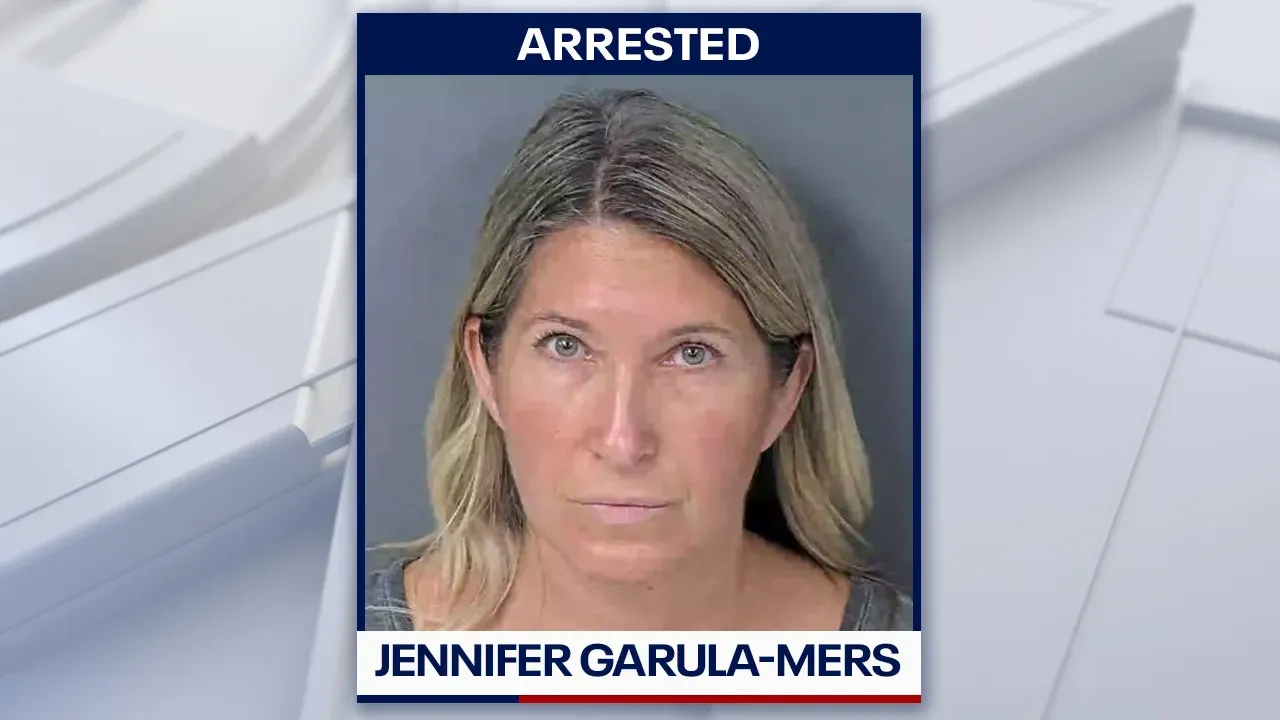
Most of the people who end up on my Seven Most Interesting People list are there because of good and positive things. Not all, but most. In this case, Jennifer Garula-Mers appears on this list for an entirely bad thing.
She was recently arrested and indicted for Grand Theft:
A Polk County Sheriff’s Office investigation culminated in the arrest of the former CEO of The East Polk County Association of Realtors (EPCAR) on Thursday, November 20, 2025. Garula-Mers was terminated from her employment with EPCAR in August 2024.
Detectives issued a warrant for the arrest of 53-year-old Jennifer Garula-Mers of Spring Hill, Florida yesterday, November 20, 2025 for Grand Theft over $20,000 and less than $100,000, F.S.S. 812.014(2)(b)(1). She was taken into custody yesterday by the Hernando County Sheriff’s Office.
Since she has not been found guilty, I will assume she is innocent for now. But it don’t look good. The news conference by Sheriff Grady Judd has gone semi-viral within the industry because of how entertaining he is, but also because of how awful the story is:
I wrote about her case recently in this post, and I find the story to be tragic in all sorts of ways, as well as enlightening and educational.
Now, to be fair, I could have named Shauna Marie Love, (former?) CEO of Tuolumne County Association of REALTORS as well since she was arrested days after news of Garula-Mers broke. But the details that Sheriff Judd presents are important for the rest of us because they point to flaws and weaknesses in organized real estate. Knowing the problems means coming up with solutions.
On the surface, the problem appears to be lack of effective financial controls. Somehow, the Board failed to discover the alleged theft until too late. The obvious solutions then are stricter policies and controls.
That is not the real underlying problem, which means the solution is inadequate.
The real underlying problem comes straight from Sheriff Judd, as he says right up front in the press conference:
This all started in n about 2021-2022, when a REALTOR by the name of RJ Webb was elected President of the Association. And he began to notice things that were inappropriate. So as President of the Association, at the board meeting, he challenged the Executive Director to see documents, to see financials, to see information. The Executive Director absolutely refused to show the President of the Association the appropriate documents.
Not only that, the Board of Directors backed up the Executive Director, Jennifer Mers, as opposed to their own President, RJ Webb. They said he was just trying to cause trouble. [Emphasis added]
It doesn’t matter what kinds of financial controls are put into place, if the Board is going to back up the AE who refuses to share financials, and then rallies around him/her, and isolates the director who is asking questions. Corruption is entirely too easy if the Association is dominated by groupthink, by secrecy and “don’t rock the boat” culture.
Garula-Mers, Shauna Love, Katherine Junge, Brenda Free, Kelly Whitman-Bower, Jennifer King, Kristyne Shelton, Laura Flournoy, Piquette Scribner, Sharon Jones, and others were able to perpetrate crimes (allegedly in some cases, proven in others) because of the omerta culture of the Association.
They got away with it for years in some cases, stealing unbelievable amounts of money in some cases, because of the culture of secrecy, of confidentiality, of personal politics, of factions, of mutual backscratching that is so common in REALTOR world.
As NAR embarks on its new 3 year strategic plan, Nykia Wright, the CEO of NAR is swearing up and down that transparency is the priority:
Wright said the organization had ushered in a new era of transparency that she said would become a standard for NAR. As part of that effort, the group is preparing to release an annual report and a strategic plan for the coming three years.
“Transparency is not a one-time effort,” Wright wrote. “It’s the new normal.”
…
Wright also said that the organization would release a 2025 annual report that would provide “additional context” to the group’s annual nonprofit filing. It will also shed light on NAR’s priorities for 2025 and its goals for 2026, she wrote.
“The report will provide valuable information about how NAR is staying accountable to its members, the industry and consumers and how it operates with the highest levels of financial diligence,” she wrote. “It will not resemble a publicly traded corporate financial statement, but it will represent a new level of transparency for NAR.”
Neither the strategic plan nor the annual report are finished, Wright wrote. But both would provide an “unprecedented level of transparency” into NAR, she wrote.
I hope she means what she says, and that NAR will deliver on the promise of transparency. But yet another summary report is not going to get it done, neither at NAR or at local Association levels. What is needed is a change of culture, from the top down and bottom up. So what would get that done?
First, NAR should voluntarily submit itself to a forensic audit, conducted by specialist accounting firms. A forensic audit is orders of magnitude more difficult and expensive, and it is specifically designed to uncover wrongdoing. There is a good chance that there is no wrongdoing at NAR so forensic audit is clearly overkill.
But if NAR wants to usher in the era of new transparency, there is no better way to silence all naysayers, critics, and conspiracy theorists. I am often called one of those. Well, it would be easy to get me to STFU with a forensic audit.
Second, NAR should mandate that every REALTOR Association must conduct an annual audit and make it available to all members. If a small Association can’t afford an annual audit, then NAR should pay for it. Cut some of the PR and marketing budget doing the useless “REALTORS have a Code of Ethics” nonsense and spend that on financing audits.
Third, NAR should pass a new policy and enforce it down the chain that any member (or a sufficient number of members) in good standing has audit rights, the way shareholders in a privately held corporation has audit rights. Simply by giving members audit rights, the REALTOR Association becomes open and transparent.
It is abundantly clear that Dar al REALTOR needs to do something big to prove that it is transparent to its members. It is abundantly clear that Associations must restore trust not by talking about it but by doing something to earn that trust.
For making the rest of us see it as clear as day, by (allegedly) engaging in dishonest, unethical, and criminal behavior, Jennifer Garula-Mers is one of the seven most interesting people in real estate in 2025.
Official Bio:
None available.
6. Rebecca Jensen, MRED

It is, I think, entirely fair to say that most of the 530ish MLSs in the United States looks at private listings the way vegans look at medium-rare steaks: something immoral and disgusting, and vaguely threatening to their way of life. It is the MLSs, after all, who lobbied for and got passed Clear Cooperation Policy at NAR in the first place to remove a competitive threat to their monopoly on listings.
But unique among MLSs is Chicagoland’s MRED, led by Rebecca Jensen.
As I detailed in this post about the coming battle between Zillow and MRED, MRED has offered private listings and Coming Soon since 2016—long before NAR promulgated CCP.
Its white paper on private listings and Coming Soon, originally written in 2019 and updated this year, mounts a robust defense of its private listings policy:
MRED’s Private Listings accommodate pre-market “Coming Soon” listings as well as listings that would otherwise be kept off the MLS.
MRED Private Listings are a pro-MLS policy combined with a software solution that supports a variety of scenarios where off-MLS listings are required. In effect, MRED has created Private Listings so that agents do not have to go around the MLS to promote certain properties that are not appropriate to be featured as a Standard MLS listing.
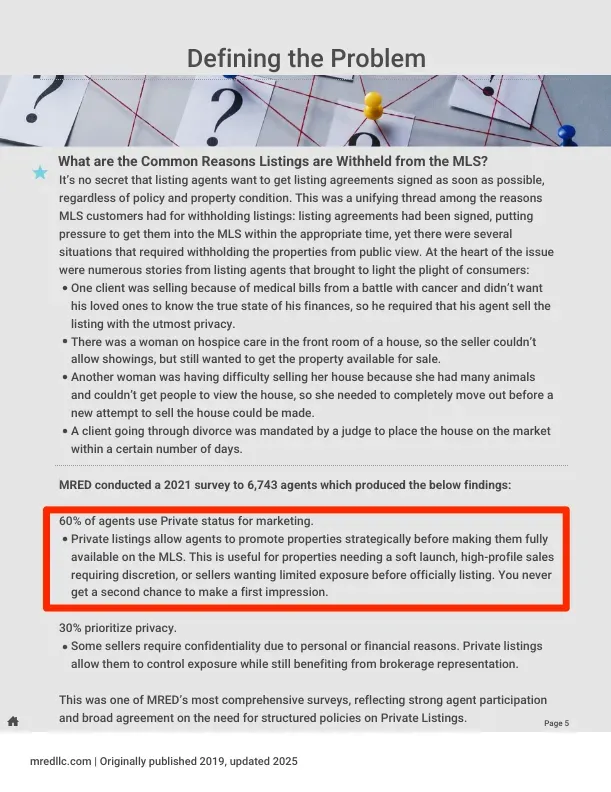
The white paper is filled with charts and graphs and data, including eye-opening stats like this one:
MRED’s white paper stands in stark contrast—indeed in opposition to—white papers and studies released by other MLSs (with summaries by Grok):
- BrightMLS: This study analyzes over 100,000 sales from September 2024 to February 2025 across Bright MLS’s service area (Mid-Atlantic region). It finds private listings take longer to sell (median 37 days vs. 20 days for MLS listings), offer no price premium, and exacerbate inventory shortages—potentially increasing available homes by over 20% in some markets if shared publicly. It also notes a rise in office exclusives to nearly 8% of new listings by early 2025.
- SFAR and RealReports: Off-MLS reduces transparency, distorts appraisals, and risks discrimination/anti-competitive practices; on-MLS share is rising locally.
- Canadian Real Estate Association: Private practices benefit some but reduce overall MLS comprehensiveness, harming buyers/sellers; cites U.S. trends like Bright MLS data showing increased pocket listings
It goes without saying that MRED’s paper contradicts Zillow’s oft-cited study as well.
Perhaps as a result, MRED is often held up as the example of what a cooperative broker-centric MLS looks like by none other than Robert Reffkin in his fight for private listings.
The conflict between Zillow and MRED is escalating. Earlier this year, MRED sent this email out to its brokers:
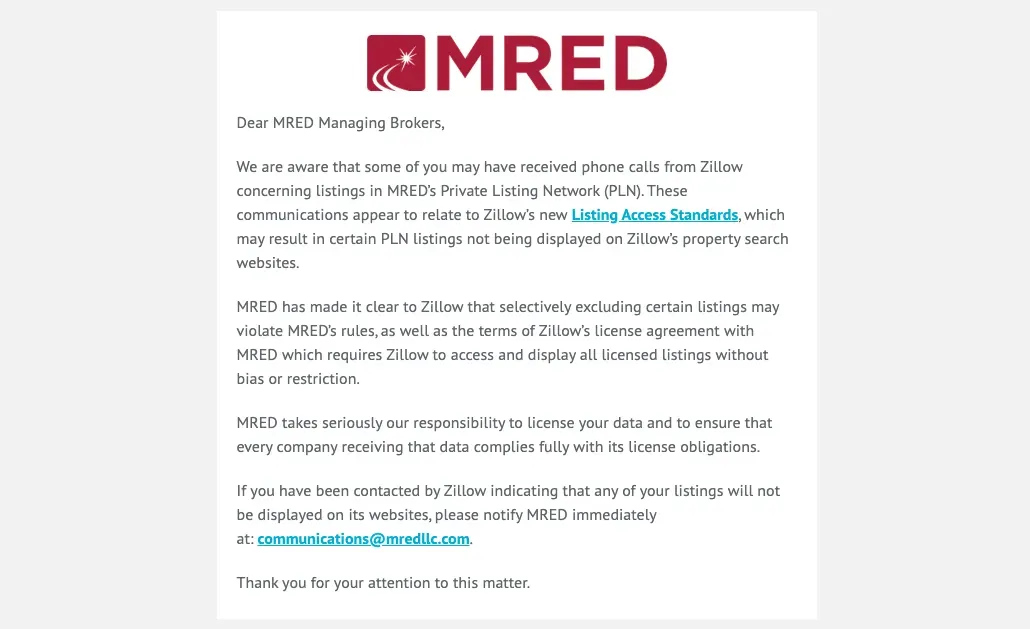
If Zillow enforces its ZLAS on MRED’s brokers—which includes, of course, Compass as a major brokerage in the area—then MRED will take action against Zillow, presumably including cutting off all data feeds to Zillow.
That is what you call throwing down the gauntlet.
I have written already about what is at stake for both Zillow and for MRED so go read that post in full, linked above.
For our purposes, it is MRED’s pole position as the MLS favorable to private listings that is so interesting. And Rebecca Jensen leads that effort into 2026 and beyond.
That effort is not limited to just MRED. In 2023, MRED held an event called “MLS Peak Retreat” which appears to be a hybrid event, bringing MLS leaders together to discuss MLS things.
Word around the campfire is that MRED held another MLS Peak Retreat in August of 2025, bringing together leaders of MLSs throughout the midwest, to discuss… things. So MRED is already doing things like bringing MLSs together.
As the 8th largest MLS in the country, as well as the MLS for the third largest city, MRED has quite a lot of influence on other industry players as well. Rebecca Jensen herself is the Chair of RESO, while Chris Haran, MRED’s CTO, sits on the board of Council of MLS, for example. Jensen is also in leadership at MLS Grid, a company that handles data distribution for member MLSs, COVE MLS Group, MLS Roundtable, and Broker Public Portal.
She is already enormously influential and powerful. But this fight with Zillow will be a major test. If MRED wins that fight, then Rebecca Jensen emerges as THE leader for the MLS community—who will mostly follow her lead in preserving their own power. If MRED loses that fight… well… does anyone remember Renly Baratheon?
She is one of the most interesting people in real estate today.
Official Bio:
Rebecca Jensen is president and CEO of Midwest Real Estate Data, which serves real estate professionals in Illinois and adjoining states. She is the board chair for the non-profit Real Estate Standards Organization (RESO) and she is the board vice chair of the Broker Public Portal. She is the board chair of the MLS Grid, an MLS data initiative that powers over 65,000 apps and websites and includes MLSs across the country who jointly serve more than 325,000 licensed agents.
Previously, Jensen has served on the boards of the Council of Multiple Listing Services, and the California Regional MLS. She has been a member of many committees and groups including those at NAR, Cove Group and MLS Roundtable. Jensen holds a bachelor’s degree in computer science and a master’s degree in business administration/technology commercialization from Westminster College.
7. Phillip Cantrell & Scott Rowland

One of the biggest threats looming over the industry, but especially real estate brokerages, is the issue of real estate forms. I have been warning about this for over a year now, after publishing this post about the danger that forms pose.
After the Sitzer lawsuit and settlement, it became obvious that plaintiff lawyers saw gold in dem thar REALTOR hills. There were and are quite a few angles for smart lawyers to extract the danegeld from real estate, but the biggest and most obvious one, I thought and still think, is the common real estate form promulgated by state associations.
Why? Let me quote myself:
Well, a key element of any antitrust claim is the existence of a “conspiracy.” No conspiracy, no antitrust. No antitrust, no liability. It’s actually black and white.
Now, we have already gone over how the word “conspiracy” in antitrust doesn’t mean what it means in plain English. But as a reminder, here’s the DOJ:In effect, the conspiracy must comprise an agreement, understanding or meeting of the minds between at least two competitors or potential competitors, for the purpose or with the effect of unreasonably restraining trade. The agreement itself is what constitutes the offense; overt acts in furtherance of the conspiracy are not essential elements of the offense and need not be pleaded or proven in a Sherman Act case.
There is a case to be made that any organization made up of and governed by competing brokerages — such as a state association of REALTORS or the local MLS — is a prima facie conspiracy for Sherman Antitrust Act purposes.
The REALTOR Associations is by definition a group of competitors getting together for one purpose or another. When that purpose is creating common real estate forms, which often dictate how the business is conducted, then you have made the job of the plaintiff lawyers far easier. Conspiracy element is more or less met.
So I wrote then:
If I am a broker of any size, I have to think twice about using a form created by “20 competing brokers in a room.” It might be a major pain in the ass, but it might make sense to create my own form without consulting anybody else.
We do know that eXp Realty created some of its own forms, and offered them to other brokerages as open source. That was a good thing to do and I praised them for doing it at the time, and the industry cheered eXp for doing it as well.
What most people don’t know is that a large but still regional brokerage did that and more… only to meet with unexpectedly hostile resistance.
Benchmark Realty out of Nashville, under the leadership of Phillip Cantrell, Founder, and Scott Rowland, President, spent enormous sums of money and expended huge effort to create its own real estate forms for its own agents. They did this with advice of counsel, and did it with lawyers not agents drafting the legal forms. Benchmark is the largest brokerage in Nashville, and was one of the largest independents in the state of Tennessee until it was acquired by United Real Estate in 2020. They had the resources to do this.
One of the major reasons why Phillip and Scott pursued this expensive route was that they wanted to simplify the forms. As he emailed me:
What we have done on the Purchase & Sale Agreement is take 5 separate forms (Purchase & Sale Agreement, Confirmation of Agency, Personal Interest, Wire Fraud Notice, and Disclaimer form) and combined them into one 9-page form. The TNR versions are all separate forms and are about 25 pages total, with lots of verbiage the consumer cannot understand.
Plus, all of this is in keeping with the push that we do not share compensation – just put in the offer and let the principals work it out. Total transparency.
To understand what they’re doing better, watch this video:
So far, all of this is simply admirable and innovative. One would think that Benchmark would be praised and Scott and Phillip would be invited to speak at various Association events.
Sadly, that isn’t what happened.
I spoke with Phillip for this post and he told me that Benchmark had gone to Tennessee Realtors to ask for cooperation when he began to create their own forms. He asked for a license for TR forms to be modified to meet his needs. He was told, in his words, not just No but Hell No. Because forms for TR was a “competitive advantage” which is an odd phrase for a monopoly. There is no other Association in the state of Tennessee, after all.
Instead of kudos when Benchmark proceeded with creating its own forms, Tennessee Realtors had their law firm send him this letter (republished with permission):
Such a letter from a law firm threatening legal action is… not something you imagine a state Association would send to one of the largest brokers in the state.
But if TR thought Phillip Cantrell and Benchmark would back down, they did not quite know the man. He responded with the following email:
Dear Angela, [Angela Shields is CEO of TR]
I’m writing in response to the attached letter I received this week from Addison Russell, General Counsel for Tennessee REALTORS®. While I understand the association’s desire to protect its reputation, the tone and implications of the letter were both disappointing and grossly misdirected.
Let me be clear: Benchmark Realty is part of the group of brokerages specifically excluded from protection in the recent class-action lawsuit settlements by NAR—settlements that cost our parent company, United Real Estate, and approximately 95 other major brokerages across the country, nearly $1 Billion dollars to escape.
As part of United, Benchmark alone bore an $800,000 charge in that process. That’s $800,000 taken directly from a company I have spent the better part of my life building. Years of blood, sweat, and tears creating value for our shareholders, dissipated through no fault of our own. In practical terms, its money stolen from my family and my agents—simply because we were required to follow policies and practices established and enforced by associations like yours. Yet, as of this date, I have heard absolutely nothing from one single association that sounded anything like an apology or even a basic communication on how to build a relationship path forward. In my opinion, that is a gross abdication of duty and an attitude of “let them eat cake.”
Benchmark Realty has every legal right to examine the documents and tools we provide to our agents. If we find those documents to be potentially problematic in today’s shifting legal environment, we are not only permitted—but obligated—to take corrective action. That is not defamation; it is sound leadership.
As a former local association board member, multiple committee member, major RPAC contributor, and even REALTOR® of the Year, I have for many years tried hard to remain neutral on the value of association membership, despite the increasing ridiculousness. But I must tell you that this thump on the nose from your counsel, which is clearly intended more to intimidate than to collaborate, has moved my stance from apathy to active skepticism—if not outright opposition—toward the role and behavior of REALTOR® associations, and most especially yours. Firing off such a baseless letter to one of your largest members without even a phone call first, should give your leadership serious cause to examine your effectiveness in your current role. It certainly would within our (for profit) organization.
If the association has a legitimate legal complaint, I encourage you to pursue it. Otherwise, please do not again waste my time—or yours—with veiled threats. I have a large organization to lead, and my focus will remain on protecting the professionals who trust me to do exactly that. Again, that is not defamation; it is sound leadership. [All emphasis in original]
The response from TR has been, to date, silence. Not even an attempt to explain or ameliorate the situation. It was, instead, crickets to quote Cantrell.
Scott Rowland, who recently took over as President, was there all along the way to fight for Benchmark and its agents and clients. The two of them were a team on this effort to solve the forms problem.
What makes Phillip and Scott so interesting is that they are not particularly unique. If you watch the video embedded above, what comes across is their commitment not only to their agents but to the clients. They want to simplify things for the clients, at the end of the day. They want—and insist on—their agents doing the right thing, not just to avoid lawsuits but because it’s the right thing to do.
I believe many brokers are just like them. They are also committed not just to their agents, but to the clients of the firm. They also want to simplify things. They also want, and insist on, their agents doing the right thing because it’s the right thing to do. Not all of them have the resources to create their own forms, and even fewer of them would have the stones to stand up against their state Association threatening them. But Phillip and Scott do, and they did.
They are among the most interesting people in real estate in 2025.
Official Bios:
Phillip Cantrell
Founder, Benchmark Realty
EVP of Strategy, United Real Estate
Cantrell is the Founder of Benchmark Realty, LLC, a thriving real estate brokerage with offices in Tennessee, Kentucky, and Alabama, which is home to nearly 2,000 licensees. In 2025, he ranked #163 in the Real Estate Almanac 2025 Swanepoel Power 200, a listing of the 200 most influential people in the industry.
In addition to continuing to help guide Benchmark, Cantrell occupies a parallel role as EVP Strategy for United Real Estate Holdings. With over 21,000 agents and annual revenue approaching $20 billion, United is ranked as the #1 fastest-growing residential brokerage in the country by RealTrends.
A 23-year real estate practitioner, Cantrell has been published across multiple industry trade news outlets, spearheading thought leadership on a variety of pressing topics, such as leadership, commissions, class-action lawsuit impacts, buyer agency and more.
In July 2025, his book “Failing My Way to Success – Lessons from 42 years of Winning (and Losing) in Business” was released and became a #1 Bestseller on Amazon in five separate categories. Learn more at PhillipCantrell.com
Scott Rowland
President, Benchmark Realty
With over 24 years of experience in real estate, Scott Rowland has built a distinguished career marked by leadership, innovation, and a deep commitment to excellence. Beginning as a licensed real estate agent, he quickly established a reputation for market expertise and client-focused service.
Nine years ago, Scott transitioned into a Principal Broker role, spearheading the launch of Benchmark Realty’s Mt. Juliet, TN office. Under his leadership, the office flourished, setting new standards for growth and agent success. This success led to a pivotal role as Director of Operations at Benchmark Realty’s headquarters, where he streamlined processes and contributed to the company’s strategic vision.
Recognizing Scott’s exceptional leadership, Benchmark Realty appointed him as President, a role in which he continues to drive the company forward. Focused on innovation, agent development, and client satisfaction, Scott remains dedicated to shaping the future of real estate at Benchmark and beyond.
Conclusion
2024 was a momentous, pivotal year, because that was when the NAR Settlement happened, the practice changes were implemented, and the civil lawsuits were settled. I figured 2025 would be a period of chaos as the industry deals with that disruption.
I did not figure, and I don’t know that anyone did, that 2025 would also be yet another incredibly important pivotal year. The Compass-Anywhere deal is yet another inflection point, as is Zillow throwing off its vendor mantle and ascending the Iron Throne of real estate. We will see how 2026 shakes out as a result.
The seven individuals on this year’s list all reflect to one degree or another the consequences of the sea changes in the industry from 2024 and 2025. All but one will have major roles to play as thing move forward. All but one are worth watching to see what decisions they make, what moves they make, and what changes they force on their own organizations and on the industry itself.
I’m looking forward to it all. But I can only do that and deal with so much chaos and so much change because one thing does not change. That is, of course, the love and support of the single most interesting person to me in 2025 as she has been every year of our life together.