
Spelling Out the Obvious: Recruiting in the PLN Age
A journalist inquiry makes me think maybe this would be useful

Happy Monday, everybody. I hope this will be a quick post.
A journalist emailed me asking what I thought was an obvious question:
Now that Compass has closed the acquisition of Anywhere, and is likely to make its 3PM available across the entirety of the network, how do local independents and franchisee players in markets where they have dominant market share recruit agents?
I have written and talked about that for quite some time, but if a journalist is asking those questions, perhaps others—like you, my readers—also have the same questions. I mean, I doubt it since I have the best and most-informed audience in real estate, but one never knows.
Plus, many of those articles where I laid things out were VIP-only. So let me take a few minutes and share where I think things are headed and why for the public audience. I could be wrong, but if I am, I’d appreciate your input as to why.
Private Listings Are About Recruiting
I won’t belabor the point anymore than I already have; please go read my past posts on CCP and private listings if you want details.
Simply put, private listings and Compass 3PM were and are not about double-ending deals. They’re about recruiting, and recruiting productive agents in particular.
I have and can cite statistics if you need, but let’s just go with this chart supposedly from NAR’s internal reports:
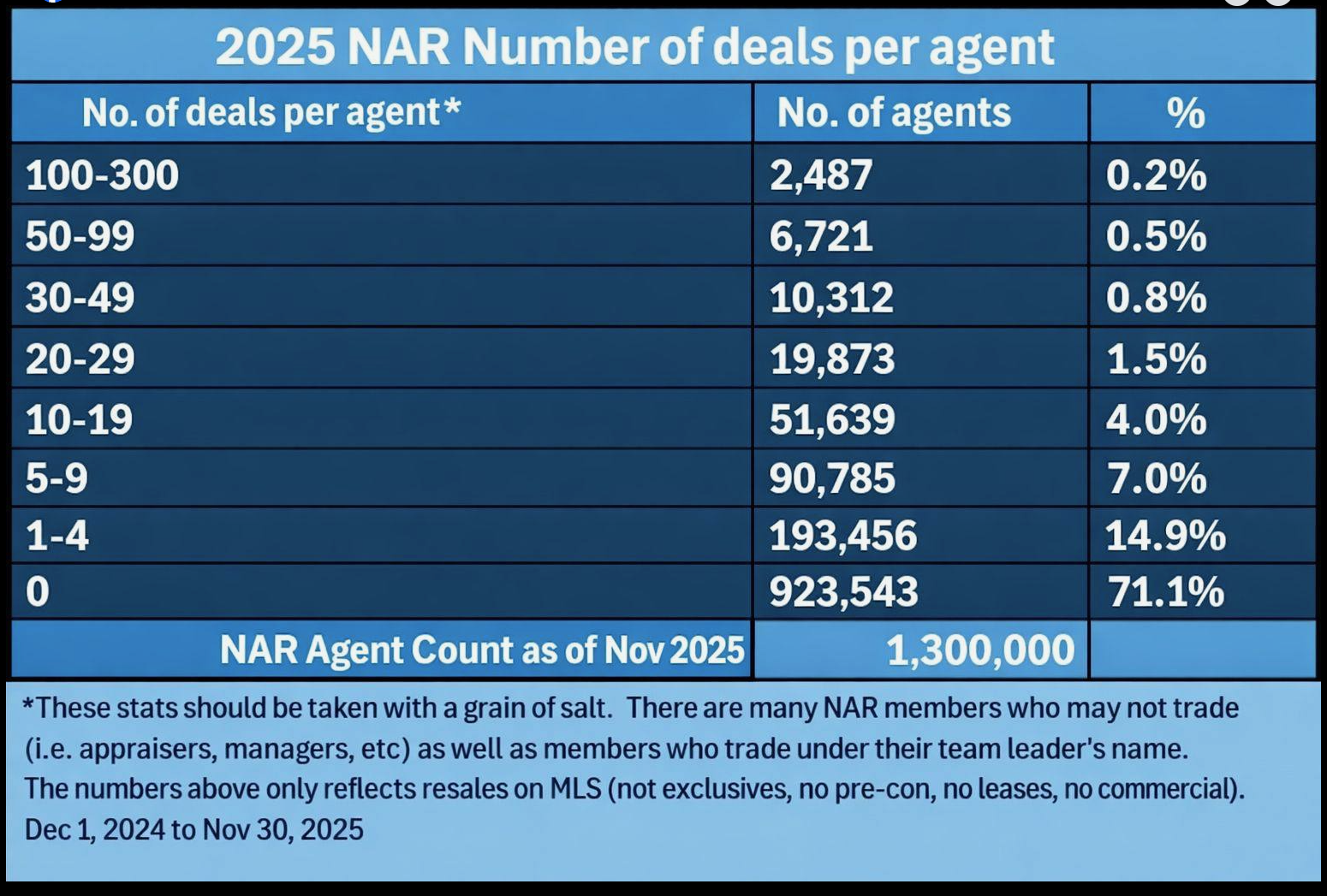
The agents doing 10+ deals are 7% of the REALTOR population; they do 70% of all transactions. 14% of agents do 5+ deals and they are responsible for 87% of all transactions.
The craziest stat? The elite top 0.2% (agents closing 100–300 deals) drove around 13% of the deals—roughly as much as the entire group doing just 1–4 deals (about 15% of agents).
Unless you are a desk-fee model of some kind, there is no benefit to a brokerage in recruiting the 71% who do 0 transactions, and precious little benefit to recruiting the 15% of agents doing 1-4 transactions a year.
So how do you recruit the top 14% of agents that actually might—just might—make you a tiny sliver of money?
Brokerage Recruiting 101
I have consulted with people who have actually done this as managing brokers. Broadly speaking, we’ve got three approaches for brokerage recruiting:
- Money (splits)
- Goodies (support, technology, office space, blah blah blah)
- Culture (i.e., you like the managing broker)
Now, training is a big one for many brokerages but… it should be fairly obvious that the top 14% and definitely the top 7% of the agents who do most of the production are uninterested in training. That’s for beginners fresh out of licensing school.
The hope may be that one of them will become a top 7% agent, but… well, it is what it is.
The fastest growing brokerages in the industry mostly use money: high splits, caps on commissions, 100% commission, etc. KW, eXp, REAL, LPT, United RE, etc. etc. all fall into this bucket. That appeals to the largest number of agents, and it also appeals to the top producing agents who don’t need anything from the brokerage other than legal compliance. (Let’s face it, there are quite a few agent teams who have hired their own quasi managing broker as a salaried employee….)
If you are recruiting based on Goodies, what do you do? What can you offer that offsets the expense of splits to a top producing agent and her team? You talk about technology, marketing support, admin support, shiny and glossy materials, and so on. You’re essentially pitching to top producers that you’ll take care of all of the necessary gruntwork so they can focus on lead generation and closing deals.
Overlaid on top of all of that is the big C-word: Culture. Every firm talks about this incessantly because frankly, it is the only real differentiator. The two big pillars are whether the agent likes the managing broker, and whether the other agents in that office are people like you, productive, driving each other, etc.
That is basically how things have been done for decades.
Private Listings Change the Equation
Private listings give the brokerage doing them an additional Goodie in a recruiting pitch. This is especially important if you are a high-cost, high-service, high-touch traditional brokerage who isn’t looking to compete on price (i.e., high splits).
Others have laid out the precise mechanics, but it’s a pretty simple straightforward pitch.
“We have all these special properties you can’t find anywhere else, so you can get your prospective buyer to work with you” is the pitch to buyer agents.
“You can offer your sellers additional options in your listing presentation” is a big pitch to listing agents.
Others—particularly Andrew Flachner of RealScout—have already pointed out the virtuous cycle this creates. More private listings —> more buyers —> more agents —> more private listings —> more buyers —> repeat.
Critical to private listings being effective, however, is the size of the network: how many off-market listings do you have access to, how many buyers looking for off-market listings, and how many other agents with potential buyers are in your network?
If you are a 5-agent independent boutique with two listings, the value of your private listings is basically nil. If you have 1,500 agents and have 30% market share in a metro area, the value of your private listings is enormous.
Compass (and former Anywhere companies) have now been handed this super-weapon in the recruiting war. Now they can talk Goodies and Culture and Private Network.
That works not only with new agents who do no business, but with top producing agents who want to keep growing market share, especially in a totally-fucked housing market.
The Compass managing broker can now call the #1 agent for the local KW office who never would have considered Compass at all, and pitch them with the size of their PLN. Caps and low commissions are awesome, but not if you’re losing deals to Compass agents with their additional things for buyers and sellers.
Competing as an Independent or a Franchisee
The equation, then, is very simple.
You can’t compete against something with nothing. It is a very hard pitch to go to customers and tell them, “Yes, my competitor offers something I don’t, but you don’t need that and don’t want that.”
Smart cruise control? Pshaw—you already know how to drive, right?
Gigabit internet? Puhleeze, you’ll never need more than 70MB downstream.
Camera on the cellphone? Why in the world would you want that when you can have a far better separate digital camera?
None of those have worked and won’t work. Customers want more options, want more stuff (or far less cost), and you claiming they don’t need it has never actually worked.
So other brokerages have no choice but to offer private listings and private listing networks. They can and have talked until they are blue in the face about how doing private listings is evil, hurts black and brown people, and might mean legal liability. None of those have worked to date.
Zillow’s threats appear to have slowed the spread somewhat, but we’ll have to see in the aftermath of the Compass deal.
Franchisees have an easier path forward: their national franchises must offer a PLN. The dozen KW offices, for example, in a metro area could then pool their listings, agent counts, and buyer databases together to claim they are competitive against Compass. I have trouble imagining how a national franchise brand survives in 2026 and beyond without offering an internal PLN.
Independents, however, face a much more difficult challenge.
Some independents may have enormous local market share. They must offer internal PLNs, of course, in order to hold on to their top producing agents. They might need to couple that with Money and even more Goodies, which will erode their already thin margins… but hey, it is what it is.
Other independents may be specialized boutiques working a small niche: Hollywood celebrities, Michigan fishing shacks, Maine hunting lodges, etc. They’ll be fine since none of the bigger guys are all that interested in such niche practices.
Frankly, every other independent is screwed. They can and will attempt to use the MLS or state laws to ban or slow PLNs. Whether these independents have that kind of leverage or not is market-dependent and remains to be seen. And depending on the market, whether the MLS has that kind of leverage remains to be seen. Don’t forget that 7% of agents do 70% of the transactions; which brokerages are those 7% of agents part of?
One Effective (?) Way
As I see things today, one possible and effective way for independents to compete may be to leverage third party PLNs plus price. (There are other strategies, but those are highly dependent on who/what/where/when.)
Top Agent Network has been blessed by NAR as not a violation of CCP. Sure, individual MLSs can make their own rules, but see above re: MLS leverage.
Seems to me that if an independent can fully embrace these third party PLNs and offer more money to their agents than the Big Boys are willing to, that’s one way to compete for the top 7% of agents.
“You can have all the PLNs you need with Top Agent Network, with agents from all these other firms, and I’ll give you high splits and caps and marketing dollars and whatever.”
I put a question mark up there because it is by no means a given that TAN and PLS and others will be allowed to proliferate. The MLS will go after them, and so will the Big Boys with their internal PLNs. So we’ll see.
A Final Note
I realize that I may be very much in the minority telling independent brokerages that they can’t compete as they are today. I have a feeling that most of the brokerage consultants, recruiting consultants, and others with a ton more experience than me will be telling broker-owners that Culture is more important than anything else, that Compass may be big, but real estate is local, and it’s all about relationships.
That may be the case.
However, I can’t forget the story that Sunny told me when we first met.
She told me the story of one of her agents with whom she had as tight a relationship as possible who walked into her office crying. That agent was just devastated that the offer from a competitor was just too good monetarily to turn down, and she spent many minutes and many words telling Sunny just how awesome she is, just how much she loves her, how she respects her, and so on and so forth. She was still leaving though because “I have to do what’s right for my family.”
As she was walking out, she asked Sunny, “You’re still coming over for dinner Thursday right?”
Sunny did go over for dinner Thursday night. Relationships are relationships.
But relationships are not always recruiting for the brokerage.
If you’d like some strategies for dealing with what’s actually coming, that isn’t sugar coated to make you feel better but aimed at actually making a difference, reach out.