
Seven Predictions for 2026: The 80s New Wave Edition
I just can't get enough of the killing moon lighting these pictures of you, because how soon is now?

Welcome to Seven Predictions, sure to be wrong or your money back. (Does not apply to VIP subscriptions.)
This is one of my favorite annual traditions. These predictions are meant to make you think about the industry, rather than be correct. But then again, sometimes… they’re spot on: I just had one of my best years predictions-wise last-year, going 4.5 for 7.
Which means I gotta get farther out on the ledge! Some of the obvious predictions, such as the Three Way Agreement going away, which I made last year, are certainly on track to become reality in 2026, maybe 2027.
As longtime readers know, each year has a different musical theme. What I couldn’t believe looking over past year’s themes is that I had never once done 80s New Wave. I am a child of the 80s, growing up in Long Island, NY. That means I came of age with WLIR (one of a few radio stations that regularly played New Wave music) providing the soundtrack of my youth. I couldn’t believe I had never showcased the awesomeness that is new wave music.
While it is impossible to pick a mere seven songs out of the hundreds I love so dearly, I do hope my fellow GenXers and the younger generations who appear to have some nostalgia for the 80s (see, e.g., Netflix Stranger Things) will enjoy this selection and be inspired to discover the greats of 80s New Wave.
This will be too long for email. Click on through to the website to read the whole thing—and to listen to the fabulous music!
1. NAR Settlement Gets Overturned on Appeal
In May of this year, I wrote a post that wasn’t the least popular but wasn’t the most popular either. It was a bit heavy on legal analysis and likely bored most of my readers; I totally get it.
The post was titled It Ain’t Over Till It’s Over: Analysis of Monestier’s 8th Circuit Brief:
The topic is the appeal filed by Tanya Monestier in the 8th Circuit Court of Appeals in the Burnett v. NAR case. In case you missed it, I wrote about Monestier and her objection to the NAR Settlement Agreement last year. She objected as someone who would be covered under the Settlement—a home seller during the time period in question. Except she’s no ordinary seller; she is a law professor at University of Buffalo who has been all over the industry with respect to the Settlement as well as forms promulgated by state REALTOR Associations. Well, her objection having been overruled by the trial court, Monestier has filed an appeal with the 8th Circuit to overturn the Settlement. Her brief arguing for that is now available, and I spent some time looking it over.
I thought Prof. Monestier’s objections to the settlement were powerful and quite convincing. A summary of her arguments:
Inadequate Relief: After fees, ~40 million class members share ~$650M, yielding ~$16 per person—vs. average damages of ~$11,450 per seller (0.1% recovery). The monetary payout is tiny, so approval hinges on the value of injunctive relief (NAR’s practice changes). Those practice changes, she argues, are worthless because:
The injunction doesn’t eliminate cooperative compensation (just moves it off-MLS); steering persists.
Agents use workarounds (e.g., touring agreements, post-facto modifications).
There is no actual enforcement (NAR self-polices, with conflicted class counsel as backup).
That makes the Settlement a Rule 23 violation and must be vacated.
Lack of Article III Standing for Injunctive Relief:
Class consists of past home sellers; practice changes benefit future buyers/sellers, not the class.
Plaintiffs lack “imminent future harm” (no definite plans to sell again soon).
Even if they did, plaintiffs now “know” the system (via litigation), so they can’t be deceived/harmed again.
Plaintiffs’ own statements emphasize helping future consumers, not themselves.
This is a constitutional law problem, and one that federal courts cannot just ignore.
Procedural Flaws: District court copied plaintiffs’ proposed order verbatim (including errors), failing independent review under Rule 23 (requiring settlement to be “fair, reasonable, and adequate”).
She argued that the Settlement must be vacated and remanded because on the whole, it provided negligible value to the class, making it not “fair, reasonable, and adequate.”
It appears that the 8th Circuit Court of Appeals has set a date for oral arguments in the appeal for January 14th. Which means we will have a decision sometime in 2026, probably in the Spring.
I predict (sincerely hoping to be wrong) that the 8th Circuit will vacate the NAR Settlement and remand the case back to the lower court. That new settlement—if one can be reached—will have to deal with the Article III Standing issue which means dealing with the Rule 23 issue, as they are interwoven.
Put differently, either money damages have to go way up, or the practice changes have to be extremely severe and worth something to home sellers who already “overpaid” under the old system, or both.
The result of vacating the NAR Settlement, of course, would be pure chaos in the industry. As I wrote in my post:
Not only that, if the 8th Circuit does reverse the Settlement… just imagine the chaos that would ensue in the industry. We just spent a year putting new rules into place, entirely new systems in many cases, new rules, changes to forms and millions of man-hours spent on training agents on how to do business under the Settlement.
All of that goes out the window, and uncertainty as to what the new new rules will be after the next Settlement negotiations happen.
NAR settled for about $1B, and the various brokerages in the $2B club settled separately for many many millions of dollars. But if the Settlement is vacated, because the average class member gets $16… then monetary damages have to go way up.
While I wrote a post already about the size of damages in Sitzer/Moehrl, let’s just keep it simple to what the appeal case already acknowledges: 40 million people in the class, who “overpaid” by $11,450 on average. That’s $458 billion. Say the new Settlement gets to 20 cents on the dollar—that’s still over $100 billion to NAR and the various brokerages. In fact, 10% paid out is still $46 billion; I’m not sure the industry could pay even ten cents on the dollar.
Which means the new Settlement has to concede some kind of injunctive relief that the 8th Circuit would view as being “worth” $400ish billion to members of the class. Not to “consumers” in general, but to the 40 million in the class.
I have no idea what sorts of practice changes and reforms could possibly be worth any money to any member of the class here. I don’t know that anybody else—including Prof. Monestier—does either. Those negotiation sessions won’t be any fun either since the plaintiff lawyers already agreed to $1 billion; they’ll now be forced to go try to get enough money out of NAR and the brokerages to meet whatever Rule 23 requires.
But they will have to figure out how to get the balance right between money damages and injunctive relief to get the court to go along, while Tanya Monestier is watching like a hawk.
2. The Zillow Home Loans Lawsuit Goes Nuclear
In September of this year, a major lawsuit against Zillow was filed: Alucard Taylor v. Zillow. My initial take on it was kinda… meh. I wasn’t all that impressed with it and said so:
I have now reviewed the Complaint and… well… to be frank, if this were filed by some local ambulance chaser, I think I would dismiss it out of hand. But this lawsuit was not filed by a local ambulance chaser. It was filed by Cohen Milstein and Hagens Berman, the mega class action plaintiff firms behind Moehrl v. NAR and Sitzer v. NAR and others. They are some of the best lawyers in the world, and they have the resources to throw at a major class action lawsuit.
As if they had heard me, the two killer plaintiff firms filed an amended Complaint in November that was significantly stronger and scarier than the original. The Amended Complaint added in a RICO charge and then really expanded the RESPA violation claims. It’s as if the lawyers from this case read the complaint in Armstrong v. Zillow (which I wrote about here) and then decided to coordinate. It isn’t as if the guys at DiCello Levitt, a Chicago-based powerhouse, don’t know who Hagens Berman and Cohen Milstein are.
Not surprisingly, the two cases have now been consolidated into one court under the Taylor v. Zillow name. Which means Zillow will face the combined might of three of the scariest law firms in the plaintiff’s bar.
But, Zillow has competent counsel as well. So I don’t know and am not predicting any major developments in Taylor v. Zillow itself. The case will be fascinating to follow, of course, but that isn’t the nuclear disaster I think will happen.
No, the Taylor v. Zillow case going nuclear will come after the initial motions to dismiss and such. The key will be whether and how one claim against Zillow is disposed of in the motion to dismiss.
You see, both Taylor and Armstrong claim that Zillow encourages (“aids and abets”) Premier Agents to breach fiduciary duty to clients. In both cases—one having more to do with Premier Agent, and the other having more to do with RESPA and Zillow Home Loans—that argument felt like it was added to bolster the core claim: that Zillow coerces/forces agents to pay them and to send mortgages their way.
Because proving the whole “aids and abets” a breach of fiduciary duty requires a showing of intent to induce a breach, I don’t really think that claim goes that far against Zillow. However, if the court dismisses that claim against Zillow, while acknowledging even tacitly that the breach was at the agent level… then watch out. In other words, if the ruling is something like, “Yeah, there was breach of fiduciary duty here, but Zillow is not responsible” then the whole situation goes nuclear. For the industry.
I went into this in some depth in my coverage of the Armstrong case:
In the aftermath, however, I imagine that a swarm of lawyers will descend upon the brokerages whose agents are Zillow Premier Agents (especially if they are Zillow Flex agents) to sue them for breach of fiduciary duty. If the case goes to trial, or even if there is a formal opinion from the court saying that agents breached their fiduciary duty because of pressure from Zillow, then it is a near certainty that brokerages will get sued.
Go read that post if you want more detail, but I do think that 2026 opens the floodgates to brokerages getting sued under state law for breach of fiduciary duty, because they had a Zillow Flex team under them. That’s the case going nuclear.
Because damages in a breach of fiduciary duty case typically involve “disgorgement of profits”, the affected agents would have to pay back the commission. If they can’t pay it all back, then the brokerage is jointly and severally liable. Imagine being on a 80/20 split, but having to pay back 100% of the commission because the agent is flat broke.
Even if Zillow were to settle the lawsuit, that floodgate will still be open. Why? Because any settlement in Taylor can only be with the class of plaintiffs going after the defendants: Zillow, Works Industries, GK Properties, and Frano Team. Defendants not named are wide open.
The danger is not limited to Zillow Flex teams. The concept here is that if an agent fails to disclose to his client that he has to pay a referral fee, then he is in breach of his fiduciary duty. We can then throw in agents who use OpCity (now part of Realtor.com), or any other referral-based lead-gen system.
Brokerages will suddenly find themselves dragged into yet another big lawsuit that they had nothing to do with. Or at least face the prospect of being dragged into a lawsuit. And so they will react like business people would.
It isn’t fully clear how brokerages will handle this. One rational way would be for brokerages to flat out prohibit any of their agents to do business with Zillow Flex or OpCity or any other referral-based company. Imagine the impact from that.
Or maybe they modify the independent contractor agreement to exclude agents who do referral lead generation from E&O coverage and get indemnification from them. Neither of those will be met with shouts of joy from agents—nor would Zillow, Realtor.com, or others be cool with that sort of thing. Yet, that could be an outcome.
In the aftermath, quite a few brokers, agents, Zillow, Realtor.com, and numerous others may be singing, Heaven knows I’m miserable now.
3. Antitrust Litigation Around Standard Forms Hits
In June of 2024, I wrote a post titled, A Warning on Forms. In it, I warned that real estate forms are mostly created and maintained by state REALTOR Associations and accordingly pose a real threat of antitrust liability to brokerages who use them:
If you use the Association or MLS forms, there is a pretty decent chance that you could be dragged into a “conspiracy.” That is especially true if anyone affiliated with your company sat on a Board of Directors of the organization that created these forms. (For example, there is someone from Compass who sits on Bright MLS’s board.)
Go read that post in full if you want to get into the legal issues.
I also recorded a podcast in February just looking over Idaho Realtors forms where I went over some substantive issues. I specifically warned that brokers could and would get swept up in any antitrust lawsuit that is brought. I heard from quite a few people that various state Associations were pissed at me for saying such things, and apparently, I’m on some kind of a blacklist to boot, because I am somehow “against them” when in fact, I am trying to save them from obvious liability.
 Rob Hahn
Well, I think 2026 is when the obvious becomes reality.
It is hardly a secret that thar’s gold in dem REALTOR hills if you’re a plaintiff lawyer. The big guys like Hagens Berman, Cohen Milstein and DiCello Levitt have already gone after Zillow. A bunch of firms will go do the breach of fiduciary duty lawsuits, but those are agency law cases.
If you’re into antitrust litigation with its treble damages, what promising gold veins remain?
Suing large state associations of REALTORS and the large brokerages who are members and use their forms seems like it could be worth the hassle.
Let’s just take Idaho as an example, since I used them in my video. According to Grok, 22,164 homes were sold in 2024 for a sales volume of about $10.8 billion; 2025 is estimated to come in around $14 billion as prices rose and number of units might have ticked up. So let’s just say $25 billion in round numbers for those two years.
The lawsuit will claim anticompetitive use of standard forms so people overpaid commissions—same economic argument as was used in Sitzer. Say they want damages using the same formulation:
Total commission paid with rates over 1.55% (which is basically all of them)

minus

Total sales price x 1.55%
Using that formula, we get to $987.5 million in damages. Just like in Sitzer, plaintiffs sue Idaho REALTORS, all of the small local Associations and MLSs who enforce the forms, and of course big brokerages. (Franchises will be harder to sue because of their settlement agreements in Sitzer made them no longer require REALTOR membership.) So plaintiffs drag in Silvercreek Realty, KW Boise, eXp, Anywhere (Coldwell Banker), Re/MAX franchisee, BHHS, Compass, and others.
They could probably expect a settlement for some fraction of the nearly $1 billion; maybe 20 cents on the dollar to make it go away? Seems like a nice payday for not a tremendous amount of work. So call it $200 million.
That’s one state, which happens to be the 37th in population among the 50 states. There are 36 states with more people, and therefore more real estate sales, and therefore more money to go after. If those state associations mandated the use of forms they created… well, plaintiff lawyers have conferences too and share information with one another.
I thought this would be a lesson the industry learned after Sitzer. Whenever a group of competitors get together in committees or boardrooms to create mandatory rules, it doesn’t matter how innocent you think the purpose is. It’s a sin in antitrust.
4. Private Listings go mainstream
The battle of private listings and private listing networks (“PLN”) was, in some way, the story of 2024. And in 2025, Zillow abandoned its role as a vendor and became a regulator, taking the throne that NAR abandoned, because of its concerns about PLNs. That in turn led Compass to sue Zillow, and that fight will go on for years. ZLAS also sparked a major war of words between industry players, with Compass and Howard Hanna and others on one side, and eXp and NextHome and others on the opposing side. A lot of fairly strident and interesting rhetoric came from the issue of private listings. Of course, the battle between Zillow and MRED will be one of the signal fights for the future of the industry, to settle the question of, “Who runs Bartertown?”
All of these things have to do with private listings.
I think 2026 marks a turning point in the private listings kerfuffle: they will go mainstream.
Compass acquiring Anywhere was not on anybody’s bingo card. I think I’m kind of the guy who makes crazy and wild predictions about acquisitions in these Seven Predictions. I went back and checked all of my sure-to-be-wrong predictions in the past. I had things like Redfin acquiring REMAX, or Realogy acquiring Homesmart. I never once imagined Compass would acquire Anywhere and I suspect no one else did either.
As I wrote in my post looking at that mega-deal, that deal only makes sense if Anywhere implements the Compass 3PM strategy:
In fact, my strong guess is that the board of Anywhere heard what Ryan Schneider has long maintained—that while Anywhere doesn’t want to do private listings, if they are forced to they will, and Anywhere with its 210,000 agents and national network would be the biggest beneficiary of such a program—and decided, “Hey, why don’t we become the biggest beneficiary of private listings?”
Thing is, PLNs do not go mainstream simply because Compass + Anywhere have implemented it. As big as they are, Compass + Anywhere will still be maybe 20-25% of the market (except in certain metro areas); 75%-80% will be somebody else.
No, PLNs go mainstream because that “somebody else” will shrink over 2026. I already predicted that there would be mass consolidation in brokerage in 2025 last year, and that was from Compass acquiring @Properties in Chicago. At the time I wrote:
Unless I’m totally mistaken, Compass + @Properties likely means more than 15% of the inventory in the Chicagoland area. @Properties alone had over 20% market share. So that’s interesting to think about.
We already know that private listings is a superpower that makes it nearly impossible for small brokerages and franchisors to compete against big brokerages. We know that Compass + @Properties will be a nearly insurmountable presence in Chicago. The small brokerages will suffer, sure.
But what do the other big brokerages do?
Do they just sit back and allow Compass + @Properties to plunder their agents using “internal inventory” and market share to do so? Of course not. So what do they do?
The same logic holds, but now at a national scale, and with Compass + Anywhere.
Since the power of PLNs is not double-ending deals, like so many critics allege, but in enormous competitive advantages in recruiting and retention, other large brokerages have no choice but to scale up and take advantage of the same thing in recruiting and retention.
Therefore, other large brokerages will get bigger. eXp will likely make a major acquisition in 2026. HomeServices of America will either be acquired or make a large acquisition. They all have to, just to keep pace with Compass. But in addition, they all have to implement some kind of PLN just to keep a level playing field in recruiting and retention.
So… PLNs and private listings go mainstream. Maybe they don’t become the default, but they do become mainstream.
5. Move Moves Away from NAR
In my Seven Most Interesting People of 2025, I wrote that Damian Eales, the CEO of Move, is one of them because he has to do something:
Obviously, no one outside of Move and likely outside of Move’s senior management has any idea what Eales would do. It is, however, fairly obvious that he has to do something. A world where NAR no longer has sway over the MLS, where power is concentrated in the hands of a few top mega-brokerages, where private listings are the norm, and Realtor.com is not in the conversation is not tenable. With his track record, I think Damian Eales will make major moves and put Move (with or without Realtor.com) back in the conversation. It will be something to watch.
With the irrelevance of NAR becoming more and more accepted around the industry, I think Move has a window of opportunity to make some… er… big moves. I think Eales seizes the opportunity and makes huge impactful changes.
Obviously I have no idea what Move would or could do, but their strategic needs are:
- Un-stall traffic growth.
- A solution for listing data that does not rely on NAR.
- Actually useful/necessary tools for agents and brokers on par with ShowingTime, Dotloop and Follow Up Boss.
- Move away from referral-based revenues in light of Taylor v. Zillow.
Move cannot do any of the above while it is tied at the hip to NAR. Which means it has to move away from NAR.
I doubt they just surrender REALTOR.com or step out of the operating agreement. They paid a lot of money for that and I suspect they’ll want to get their money’s worth. It does make some sense for Move to sell back Realtor.com to NAR so that NAR can have a value proposition for itself, but it isn’t clear that NAR has the money to buy it back or the technical prowess to operate a top tier consumer portal.
But a second brand that isn’t tied to NAR? Now that makes some sense. That second portal (maybe operated under um… Move.com URL?) now can be creative and disruptive in a way that an NAR-controlled/affiliated website simply could not.
Keep in mind that Damian Eales was the CMO and COO for Publishing of News Corp which owns some 60% of REA Group. He has a ton of experience working with REA Group, Australia’s top real estate portal, which uses a seller-paid advertising business model. Maybe it’s crazy, but if anyone could implement Australia’s auction model in the U.S., it might be Damian Eales; that would be unique and innovative.
If Move successfully implements that model, or a REA-like seller-paid model, it can drop resistance to PLNs. That could give Move exclusive inventory, which would help move the traffic needle upward once again, and make Move.com relevant in the portal conversations in a way that Realtor.com simply is not today.
Maybe Move can make really smart acquisitions to shore up its broker and agent tools portfolio. I have a few ideas that I don’t need to make public. Give me a ring, Damian, if you want to know. 😀
In any event, I predict that Move makes major moves next year. All of them require separation from, or at least a distancing from, NAR. I think they do that. I think Move says hello and waves goodbye, saying, take your hands off me! I don’t belong to you, you see.
6. Redfin Launches Ruby: an AI-Powered Social Media Marketing Powerhouse
It goes without saying that everyone in real estate—like everyone in America today—is obsessed with AI. A week doesn’t go by without some proptech company somewhere, whether large established dominant players or brand new startups, talking about how they are implementing AI to enhance agent productivity, make home search more customizable and delightful, to improve marketing efficiency, and so on and so forth.
I have no real opinion on any of that, but like most people, I am also sure that AI will have a dramatic impact on the real estate industry. Why? Because it is already having an enormous impact on pr0n, that is “adult entertainment.” As I have long said, every transformational technology has to go through pr0n to prove itself, and AI is doing that already.
One enormous impact being felt in adult entertainment today is generative AI for content. That should seem obvious since that entire industry is dedicated to selling images and video. Grok lists at least a dozen prominent AI-powered adult sites. But one area of that world proving the utility of generative AI technology is how some creators are using AI clones or “digital twins” to expand their parasocial relationships.
For example, a superstar in the world of ah… “streaming” who goes by Amouranth launched a “digital twin” in 2023:
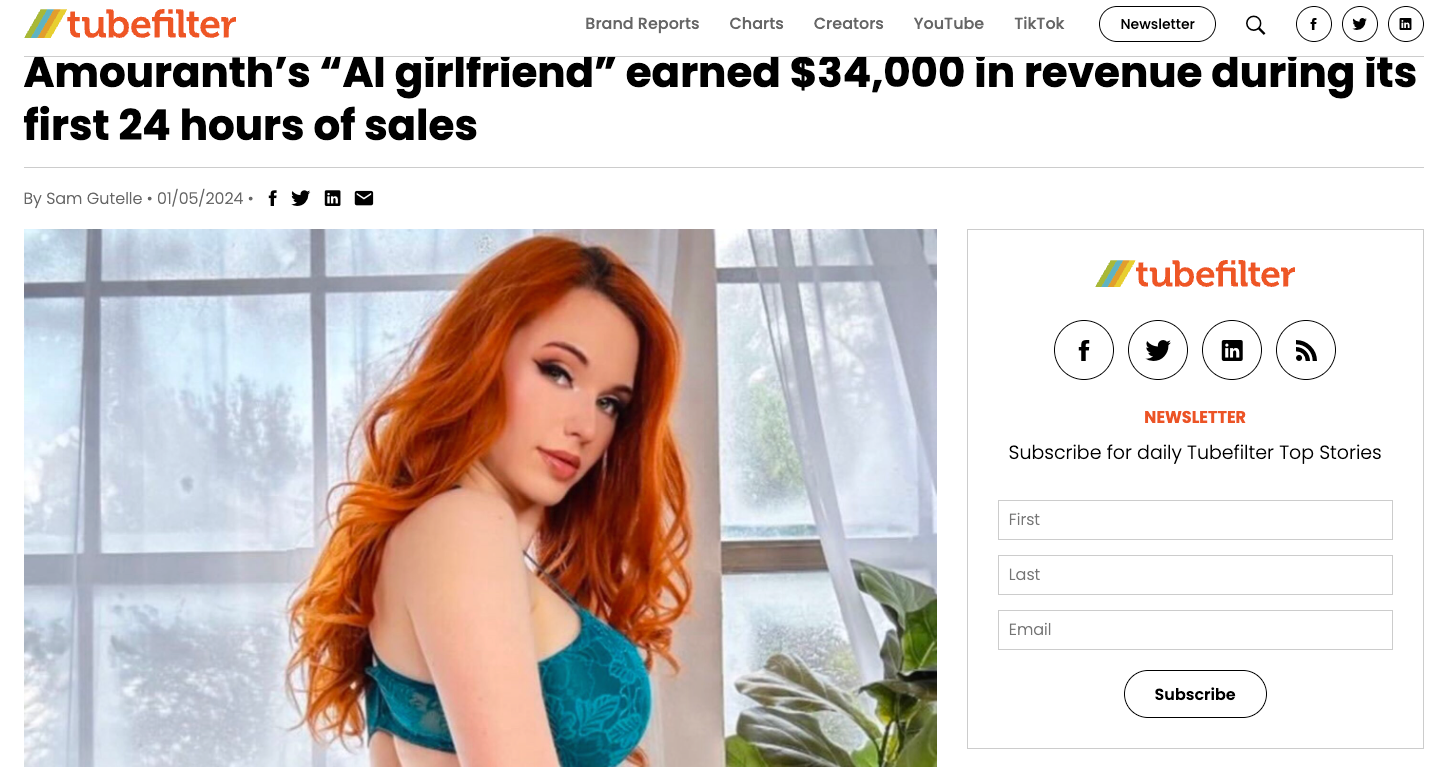
In 2025, the technology has evolved and improved according to this online review:
Enter Amouranth AI: a digital doppelgänger, powered by MySentient.AI and hosted on Fansly, designed to give you 24/7 access to her signature sass, seductive banter, and, yes, some seriously spicy roleplay. It’s like having Amouranth in your pocket—minus the risk of her blocking you for being a weirdo.
These AI digital twins and bots work because these adult content creators rely on something called “parasocial relationships” to stay in business and thrive. Grok defines parasocial relationship thus:
A parasocial relationship is a one-sided psychological connection where an individual feels a sense of intimacy, friendship, or emotional bond with a media figure—such as a celebrity, influencer, fictional character, or public persona—despite the figure being unaware of the individual’s existence and there being no reciprocal interaction.
Now, Amouranth is not unaware of the customer’s existence; no business is unaware of a paying customer. But at the same time she has no reciprocal feelings towards that person. He is just a customer, not a friend.
The hundreds of millions being spent by customers of these creators suggest that people do want a parasocial relationship, even with an AI bot they know is AI, if they can’t have a real social relationship.
Which is why I’m bringing this topic up here. You see, real estate is becoming more and more of a parasocial relationship business than the traditionalists (coaches, brokers, other agents) preach.
The top three agent teams in the country today are:
- Jason Mitchell Group (JMG) — 10,279 sides
- Mark Spain Real Estate — 9,508 sides
- Robert Slack Team — 3,933 sides
JMG doesn’t do any consumer marketing, but Mark Spain does.
And of course there are the social media superstars like Ryan Serhant, Josh Altman, Enes Yilmazer, and others. They all have thriving real estate businesses.
Here’s the thing. Contra the commercial above, there is little to no chance that Mark Spain is going to sit down with homeowners to present an instant offer to them. If you call Ryan Serhant’s brokerage, unless you’ve got some trophy property or you are a celebrity, he’s not coming to your house for a listing presentation. If you need to buy a house in California and you contact his agency, there is no chance that Josh Altman is going to drive you around and offer you advice.
In other words, except for the tiniest of tiny slivers, a client contacting these agents will be speaking to and working with someone on their team. That sounds a lot like a parasocial relationship to me.
No matter how much brokers and coaches talk on and on about “personal relationships” fact is that it is impossible for agent team leaders to have a personal relationship with 10,000 people in their spheres.
Now, actual human beings like Mark Spain and Josh Altman and Ryan Serhant have some additional barriers to overcome when deploying digital twin or AI avatar technologies. Because their fans and followers are fans and followers of the person, and just like we see from Amouranth and the OnlyFans creators, the fans know the difference.
If you are not a person, however, like… Redfin… that barrier goes away. I wrote a while back that Redfin is not really a brokerage, but an agent team but with a giant website as the team leader/lead generator. But if you take a look at Redfin’s social media presence, they sure do act like a boring-ass corporation.
I don’t know who the audience for this is, but it can’t be actual consumers who might want to hire a Redfin agent. And literally no buyer or seller anywhere has ever thought, “I should call Redfin to be able to work with Darryl Fairweather, Chief Economist.”
Redfin was acquired by Rocket this year, and has been pretty quiet while the integration work goes on. But I think 2026 is when Redfin settles in and starts out with a bang. They certainly have enough technical talent, and brilliant engineers to do really good AI, trained up on all of the data that Redfin has and can get—not to mention data from Rocket.
Which means Redfin will introduce a new AI Avatar, Ruby:

Yes, that image was generated by Grok, showing just how photorealistic AI imagery can be even this early on. Building out a social media profile featuring Ruby, instead of whatever it is that they have going on today, can only be a win for Redfin. Because they have nowhere to go but up.
Ruby can be absolutely tireless in content. See the image above? Look at this:
I made that in two minutes, using Grok. Imagine what Redfin engineers and marketers could do with some real work and real tools. We’re talking really smart, useful market updates, how-to information, advice for buyers and sellers, being churned out 24 hours a day, 7 days a week, 365 days a year with no breaks. All of the smart insights that Darryl Fairweather might have can come out of Ruby’s mouth, and get a ton more followers and a ton more interaction. Ruby will of course interact with followers publicly, then privately over chat, then hand off the prospect to a human Redfin agent… who is a W2 employee, let’s not forget.
Ruby doesn’t have to have a boring real-estate only social media presence. Just like other real estate agents who make sure to highlight their lives, Ruby can too:
Depending on the market, Ruby could be a fabulous urbanite going to the hottest parties, or a down-home country girl who could shoot, fish and ride like the boys. Did I mention Ruby is fluent in Spanish, Chinese, Tagalog, Vietnamese, Arabic, French, and the rest of the top 25 non-English languages spoken in the United States?
It won’t matter that Ruby is not real, since Redfin is not a person. I think Redfin totally relaunches with Ruby.
Yes, Redfin should pay me for this phenomenal idea. But then again, I am giving it to all of you, so… Merry Christmas!
Turns out, we are entering the era where people just look at pictures, and almost believe that they’re real, that the pictures are all they can feel. That sucks for us as a species, but hey, marketers gotta do marketer things.
7. Trump & GOP pass national zoning and environmental regs
It is difficult to miss the fact that housing, specifically the lack of affordability, has become a major political issue. It shows no sign of becoming less important as we move towards an important midterm election in 2026.
The issue is of particular importance to younger voters. You don’t have to listen to me; listen to the one guy who truly understood the importance of housing to younger voters, who has been taken from us far too soon:
Trump won 2024 in large part because the support of the youth vote. He promised massive structural change to the economy that would help the younger generations.
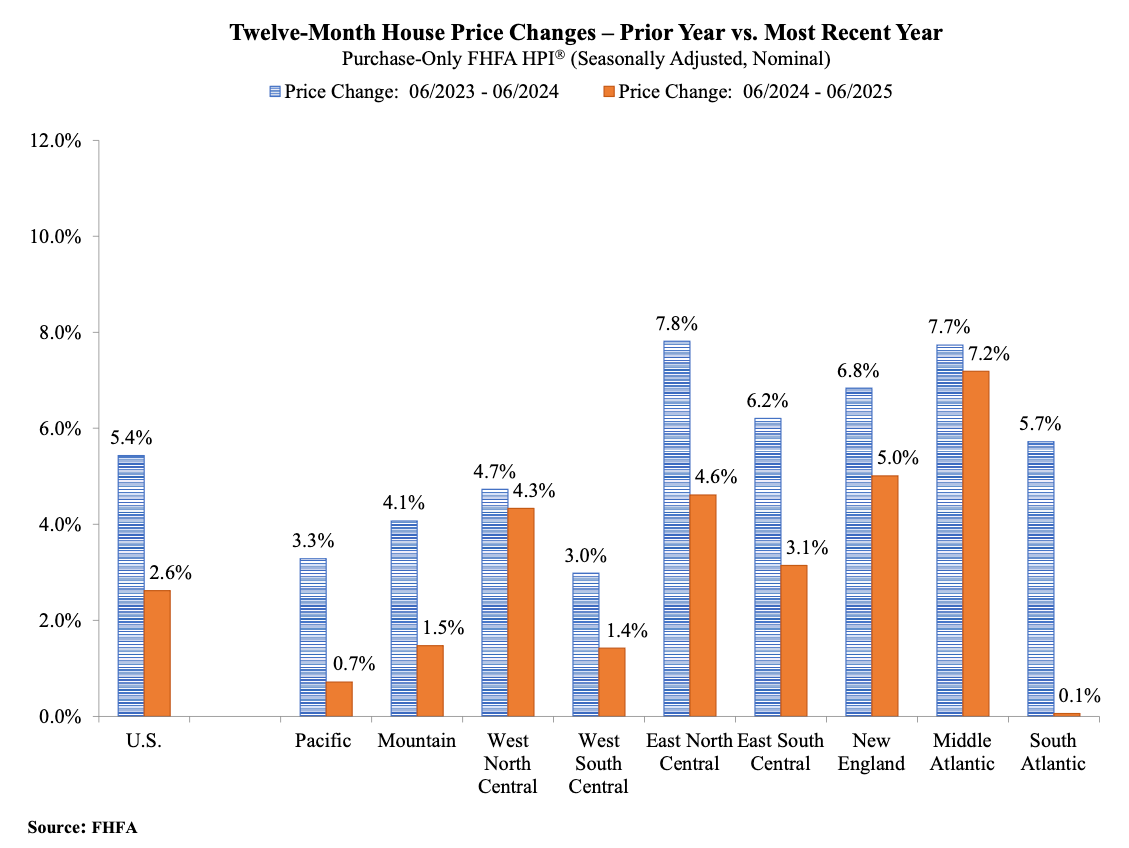
He then put his foot in his mouth as he often does: Epstein, H1B, delusional talk about the economy. Housing prices are not coming down; in fact, they’re going up.
Of course, 2026 is a midterm election year. And the Dems are feeling really good about their chances. They pretty much swept in the off-year election in 2025, electing actual communists as mayors of NYC and Seattle, along with winning NC, NJ, and VA. Meanwhile, Trump’s base is demoralized, and the youth vote has evaporated:
President Donald Trump’s support among Generation Z voters has slipped sharply in recent months, even as his overall approval rating has remained steady, according to a new YouGov/Economist poll.
The survey, conducted between October 17 and 20, found that just 25 percent of Gen Z respondents approve of Trump’s performance, while 67 percent disapprove — a net approval of –42 points. That marks a notable decline from September (30–64, –34) and August (30–67, –37).
If Dems take the House, then the Trump Presidency is all but over. Impeachment hearings will commence immediately, widespread resistance to Trump and his administration, subpoenas on all Trump allies, recalcitrance to any Trump proposal, etc. Everybody knows this.
Trump and the GOP have no choice but to do something dramatic about housing to convince the now-disenchanted young voters and blue collar working class voters to turn out for an off-year election when he is not on the ticket.
So he’s out there talking about declaring a housing emergency:
To turn the fortunes of the GOP around, I predict that Trump and the GOP attack housing affordability by passing legislation to setup national zoning and environmental regulations. It is likely not the right thing to do, but when you’re up against the political ropes, you have to do something dramatic. Yes, I know Trump already said he doesn’t want prices of houses to come down and building more would do that, but I think he changes his mind after massive pushback.
Federal zoning is probably unconstitutional since it is difficult to see how land use is a federal issue, rather than a state and local issue. However, that ship sailed during the FDR years, since literally everything involves interstate commerce in some fashion.
And once we have federal zoning regulations, all state and local zoning regs are pre-empted by virtue of the Supremacy Clause. That means Trump can lift the numerous barriers to build, baby, build and his GOP congresscritters can ride that coattail. Young people won’t be able to buy homes immediately in 2026, of course, but he and the GOP can have a compelling message that by removing local barriers to homebuilding, younger voters can dream the American Dream once again in 2027 and 2028. Plus, all that construction means jobs, jobs and jobs especially for blue collar working men—a critical constituency for Trump.
I think Democrat resistance to federal zoning and environmental regulation will be muted. Democrats are smarter than Republicans and know how to play the long game. Setting up gigantic federal bureaucracies works to the Democrat’s favor, and they know they will eventually get into power and use federal zoning and federal environmental regs to crush red states. Florida and Texas wanna do what now? I don’t think so, pal.
Nonetheless, that’s years in the future. Trump doesn’t have years. With his political future—and possibly personal freedom—at risk, I think Trump pushes every button to win the midterms. National zoning is bad policy, but it is a dramatic gesture designed for election years. He needs to tell younger voters just how they should feel today.
Conclusion
2024 was a pivot year, with the NAR Settlement (even though that may get overturned as I predicted above). 2025 was, in a way, a bigger pivot year; it’s when the seeds planted in 2024 sprouted. Compass-Anywhere might be the biggest change to the structure of the industry since the internet came into being. Zillow ascending the Iron Throne of real estate is a far bigger deal than most people realize. Both of those happened in 2025.
Now, it is true that nobody actually knows what the future holds. If you do, I urge you to stop whatever you’re doing and get a job as a hedge fund manager. I make predictions knowing that I don’t know, but the point of these Seven Predictions is not to be correct but to spur on thinking about the future based on the past and the present. As the Windrunner knight radiants might say, “Journey before destination.”
With 2025 setting and 2026 rising, let me once again thank those of you who give me your attention, all of who give me your hard earned money, and others who give me your friendship.
In 2026 I can’t promise that I’ll be writing more, nor can I promise to shut up. But I do know one thing. You read and pay attention and listen because you know that I just want the truth to be said. I may be wrong, but I am not gaslighting you. I know this much is true.
Happy New Year everybody. See you all next year!
-rsh